Lara McEvoy - 319311
Unit 13: Final Major Project
Content Research: 2.1
In this section, I am going to explore both primary and secondary research into the content of my project. The secondary research is focused on documentaries, codes and conventions, interview types, narrative theory, documentary theories as well as existing examples of dance documentaries, deconstructing them so I can gain a better understanding of how they work. Due to the topic of my essay in Unit 12, I have a basic understanding of modes of documentary, however I will do some research into them to refresh my knowledge. With the primary research I am going to explore a potential title idea so that when it comes to post-production, I have an idea of how to create it. To start with I am going to look into the codes and conventions of documentary.
Codes and Conventions (19/2/23)
In this section I am going to be initially exploring what codes and conventions are then move into exploring the specific ones for documentary. Starting my research off with this allows me to further develop a basic understanding of documentaries, more so how they are made and what makes them up. The conventions aspect of this research means I can see what content or specific areas I may need to include within my documentary so that an audience can understand that it is a documentary. I am going to explain these codes in brief detail as I am wanting to look into the documentary codes and conventions in greater depth, but I know I need to have an understanding of what the main codes are.
What are codes and conventions? Conventions are what an audience expect to see when watching a piece of media, which is made up of codes, either symbolic or technical codes. There are also different conventions within this section, such as genre, narrative/story and form conventions. Below I am going to explain what technical and symbolic codes are, then move into the documentary specific ones.
Symbolic codes -
Symbolic codes are codes that live outside of the media product themselves, they can be understood in a real-life context. Such as if someone is given a red rose in a media product then the audience would assume that there is a romantic connection/relationship between two characters; so similarly in real life, if someone were to give you a red rose, you would assume the same. The main symbolic codes are acting, setting and mise en scene (everything that can be seen within the frame).
Acting
Acting is one of the main codes within the symbolic ones, this is because actors portray characters and allow them to develop, pushing the narrative to move forward, giving the audience a better understanding of the character. This understanding is portrayed through the use of facial expression, speech, body language and movement. From each of these the audience can learn more and understand the character in more depth, while following with the narrative.
Setting
Setting is the different locations within a media piece, these change throughout the duration, moving the story along. The setting helps to create atmosphere for the audience, developing their understanding of the situation.
Mise en scene
Mise en scene is everything within the frame that the audience see. So, this is aspects such as set, costume, props and composition. The set, similar to setting, allows the audience to understand the location with ease and where abouts the characters are within that specific moment. Costume helps to show the time period that the media piece is set in, as well as the characters general style as well. Props give context to what is being said, helping the audience to understand certain objects within the frame, also works alongside the set design. Finally, composition is how the framing is positioned, how much is revealed to the audience through the composition.
Technical codes -
Technical codes are specific to the media form and don’t exist in the real world. Such as camera, editing, audio and lighting. An example of this that certain camera angles will have connotations, such as an extreme wide shot can show a new location.
Camera
Camera or camerawork includes aspects such as the positioning, movement, framing, exposure and lens choice. Each of these play a role in the audiences understanding of the narrative, though it isn’t obvious it helps the understanding, something as simple as a camera angle can actually reveal a lot about a character.
Editing
Editing is the process of choosing and arranging clips/footage into the desired order. This is a technical code because the way that the editing is done allows the audience to understand a narrative, this can be done to music (rhythmic editing) so that shots change on the beat, typically done within montage sections.
Audio
Audio is either diegetic (sound that comes from the world of the video) or non-diegetic (sound that doesn’t exist within the world of the video) within media productions. This can be further categorised into dialogue, sound effects and music, all of which help the audience to be guided through the story. These codes helps with understanding as well as dialogue explains what is going on, while sound effects add atmosphere.
Lighting
Lighting helps to highlights specific elements within a scene or set the mood/atmosphere. This includes the direction, source and colour of lights because the direction they come from can guide the audiences' eyes to a certain area of the screen, which links in with the source, and the colour needs to be realistic or fit the world of the video/film.
I mentioned above that there are also different conventions that fit into general media production, however I have made the decision to move onto looking into the documentary specific codes and conventions as I feel that this will be more beneficial for me. Also, it allows for me to continue to make progress through the research unit and not get held up by useless research. So below you will find my research into documentary specific codes and conventions.
Harvard referencing -
Young, R. (2017). Media Codes and Conventions. [online] media.codes. Available at: https://media.codes/media-codes-and-conventions-c03423c06aa8.
media-studies.tki.org.nz. (n.d.). Codes and conventions / Media concepts / Teaching media studies / Home - Media Studies Private Community. [online] Available at: https://media-studies.tki.org.nz/Teaching-media-studies/Media-concepts/Codes-and-conventions#:~:text=Codes%20can%20be%20divided%20into.
Documentary codes -
Documentary conventions are techniques that have been used again and again, which lead to them being associated with certain media production. These techniques then become known as conventions for that media production. There are 6 conventions for documentary, they are: archival footage and photographs, talking heads, jiggly camera, voiceover narration, re-enactments and real people. I am going to explore each of these conventions with examples below.
Archival Footage + Photographs
Archive material is old footage, photographs, newsreel and sometimes shots from films. From my essay in Unit 12 I found that within the documentary Free Solo (National Geographic, 2018), there is a lot of use of archival footage which helps to guide the story. Also, it helps to further the audiences understanding/give context to what the dialogue means. An example of this is at the start of the documentary when they are introducing who Alex is, they mix together shots of Alex now/in interviews then pair it with archival footage. The image shown below is used when Alex is talking about a past climb, so to give more context to it they have included the image shown below.

Personally, I would quite like to include the use of archival footage within my documentary as I feel it would help to visualise what is being said in the interviews.
Talking heads
Talking heads are people who are interviewed in order to explain/comment on the subject of the documentary. This is often done where people will be shown in places that relate to the role, they play within the narrative. Doing this allows the audience to understand multiple perspectives of a certain topic, giving a more rounded views of the subject at hand rather than one POV. Along with this the audience are shown the interviewees in a more natural environment, relating to their role, further helping the understanding of the narrative. This can also help if someone is a recurring interviewee, being in the location they are will help remind the audience of this.

A popular example of talking heads is used within the US sitcom/mockumentary The Office. In the image to the left, is one of the characters undertaking an interview, sharing their view on an event that’s just happened. This happens consistently throughout the entire show as a way of getting characters views on events within the narrative. Though this example is from a mockumentary, I feel that it is a good example of how talking heads can be used effectively.
When it comes to my documentary, I'm unsure if this will be used as I know I want to use interviews for the narrative but if talking heads comes alongside that I am unsure.
Jiggly Camera
This convention developed through time as cameras became more portable and affordable, it meant that filming was able to happen on location. With this it meant that the camera became more difficult to steady, especially when following the action, hence it has the name Jiggle Camera. This is something which can be corrected through a stabilizer, but many filmmakers don’t use this as they want the authentic feel of the action being followed. An example of this is in the documentary Welcome to Chechnya (France, 2020), as the entire time the camera is following people around the footage has a ‘jiggly’ or unstable feel to it. This convention allows for a more uneasy feel as for the audience it’s as though there was no time to get the perfect shot, the camera just needed to be following the action.
For my documentary, as it is going to be following the action, there is a high chance that Jiggly Camera is a convention I will use. Even though it may not be intended at points, this may occur without me realising.
Voiceover/Narration
Voiceover/narration is an effective convention within documentary, acting as a guide for the audience as they see images/footage relating to what’s being said. The audience cannot see the voice/speaker, they can only hear it, acting as the ‘voice of god’ so to say. Using voiceover/narration is extremely effective when the filmmaker wants the audience to understand a certain view, as sometimes it’s the only voice heard throughout a documentary, so the audience are led to believe that whatever they are saying is correct. It’s important to note that the narration can also come from interviews within the documentary, especially if they are re-telling events that have happened. From my research in unit 12, I found that this convention has been used from very early on, well as soon as sound could be recorded. For example, in Land Without Bread’s (Bunuel, 1933) voiceover/narration is used from the start to explain what’s happening on the border, so from the start the audience are listening to the voice to understand the narrative with ease.
This is a convention I will definitely be using, as I want the audience to be guided through the documentary, hearing the voices of the pupils at the dance school.
Re-enactments
Re-enactments are a popular convention used, especially when documentaries are produced after events have occurred because they are staging real events that have already happened. This is mainly done for dramatic effect to enhance the intensity of the narrative, as well as give the audience a visual aid to what’s being said in the voiceover/narration. Sometimes they will include the actual people who were involved in the event, but majority of the time it will be actors due to the fact that the events are likely to have been traumatising for those involved.
The Rescue (National Geographic, 2021) uses re-enactments to enhance the storyline and to give a visual aid for the audience. In the image below you can see that the divers are in a water tank, with a piece of set which is where the re-enactment was filmed. Through creating a real set, it helps with the believability that what the audience see is real, even though no filming actually happened when they were diving in the caves for the 12 boys.


For my documentary I don’t feel as though this will be a useful convention for me to use, due to the fact that no huge significant event will occur.
Real people
In almost every documentary that an audience watch they are shown real people. Real people allow the audience to feel as though what’s being said is authentic and has a real feel to it, because it is real. This convention is a simple one as it is what documentaries are about, sharing the opinions/thoughts from real people who have been involved in either a serious situation, or an interesting topic.
Obviously, this is a convention that I am going to use within my documentary because I am working with my dance school to create a documentary about the pupils/show.
Graphics

Graphics are used within documentaries, both simple and complex for a couple of different reasons. The main two reasons are for lower thirds, (lower thirds are a piece of text that pops up under the screen when an interviewee is introduced, giving the audience context, this was researched in unit 12) and for locations/time stamping (text that pops up in the middle of the screen to tell the audience where they are/what time something is happening). Both of these are effective in helping the audience understand the narrative of the documentary and the setting they are in. As shown in the image on the left.
Another use of graphics is to help the audience visualise what’s being said, such as in The Rescue, graphics are used to show the audience the cave system that the divers go through. Using graphics like this just helps the audience to better understand what is being spoken about in the narration/voiceover. The image of this is shown on the right.

I will use lower thirds within my documentary to help the audience understand who is speaking during interviews, and I may also use location graphics to help the audience understand where the filming is happening.
Harvard referencing -
• Young, R. (2017). Media Codes and Conventions. [online] media.codes. Available at: https://media.codes/media-codes-and-conventions-c03423c06aa8.
• media-studies.tki.org.nz. (n.d.). Codes and conventions / Media concepts / Teaching media studies / Home - Media Studies Private Community. [online] Available at: https://media-studies.tki.org.nz/Teaching-media-studies/Media-concepts/Codes-and-conventions#:~:text=Codes%20can%20be%20divided%20into.
• media.edusites.co.uk. (n.d.). Edusites GCSE & A Level Media Studies Resources. [online] Available at: https://media.edusites.co.uk/article/documentary-codes-conventions.
• Documentary Site (2020). Documentary Conventions. [online] Documentary Site. Available at: https://www.documentarysite.com/2020/02/01/documentary-conventions/.
• Dunderpedia: The Office Wiki. (n.d.). Talking head. [online] Available at: https://theoffice.fandom.com/wiki/Talking_head [Accessed 19 Feb. 2024].
• Meyer, J. (2022). The Office’s Talking Head Scenes Were Hiding A Subtle Hint About Its Characters. [online] SlashFilm. Available at: https://www.slashfilm.com/957496/the-offices-talking-head-scenes-were-hiding-a-subtle-hint-about-its-characters [Accessed 19 Feb. 2024].
• theasc.com. (n.d.). The Rescue: Heroic Extraction - The American Society of Cinematographers (en-US). [online] Available at: https://theasc.com/articles/the-rescue-heroic-extraction [Accessed 19 Feb. 2024].
• O’Neill, A. (2021). RECONSTRUCTING SCENES FOR ‘THE RESCUE’ BY ROGER DENGATE - CONSTRUCTION MANAGER. [online] British Film Designers Guild. Available at: https://britishfilmdesigners.com/reconstructing-scenes-for-the-rescue-by-roger-dengate-construction-manager/.
Next, I am going to explore the modes of documentary. In Unit 12 I undertook extensive research into the modes of documentary and how they work. So, for this section of research, I am going to look into a couple modes of documentary specifically to ensure the modes I have proposed are what I want to use within my documentary. Also, from the research in Unit 12, I was able to give examples of each documentary mode meaning that I have watched through a documentary from each mode, furthering my knowledge of which mode I think I want to use for this project.
Modes of Documentary
(20/2/24 - 21/2/23)
Bill Nichols states that ‘the documentary modes are what define the look and feel of documentary films’. Each mode has identifiable qualities that make them distinct, meaning you can tell what's an expository documentary and what's an observational one. There are 6 modes of documentary which are poetic, expository, observational, reflexive, participatory and performative. Within this section I am going to explore observational documentaries and reflexive ones with more detail, allowing me to develop a deeper understanding of how they truly work. For this I am going to be using Bill Nichols book, Introduction to Documentary Third Edition. The first mode of documentary that I am going to explore is the reflexive mode.

Nichols, B. (2001). Introduction to Documentary. Third ed. pp.107.
The Reflexive Mode -
The reflexive mode of documentary focuses on the filmmaker’s engagement within the narrative, speaking about the issues of representing the narrative given. This is what distinguishes the reflexive mode, there is an ‘enhanced level of reflection’ on what representing the narrative or world involves. Reflexive documentaries have a similar feel as observational ones, they are dependent on the filmmaker’s absence/non-intervention with the events recorded. As mentioned in unit 12, Man With a Movie Camera is one of the first reflexive documentaries made. It simply demonstrates how reality can be constructed through opening with a shot of the cameraman, who’s filming people riding in a horse-drawn carriage. It then cuts to a shot of the editing room where the audience are shown wat they have just watched being edited. Giving the audience the chance to reflect on the process by which the impression of reality is given. Within this mode of documentary there is an emphasis on the relationship between filmmaker and the audience, showing the behind-the-scenes aspect. For the narrative, the audience follow the filmmaker so are watching through their eyes/POV. Doing this allows for the filmmaker to act as the voice of the people, asking questions in a more intimate way so the audience develop a better understanding.
In unit 12, I used Louis Theroux as an example for reflexive documentaries. His documentaries are centred around Louis going and meeting either famous, controversial or interesting people, and talking to them about their life/job. The audience are shown Louis + his crew setting up the interviews, with the interviewee walking around getting ready. An example of this, the same one I used in unit 12, is in the Louis Theroux Interviews series, specifically the episode with Dame Judi Dench. In this episode we see Louis’s crew setting up all of the kit ready for the main sit-down interview section of the episode, these images can be seen below.


For the reflexive mode this is a popular way of introducing the documentary to an audience. It simply displays to an audience the process taken to produce the documentary, dismissing the illusion that most documentaries present, the audience are allowed to see the production from a behind the scenes aspect, making them feel as though they are involved within the production. Giving an opportunity for them to realise the work that goes into these documentaries being produced, even the short 30-minute ones.
In the previous section I explored documentary specific codes and conventions, however there are also codes and conventions that are specific to each mode of documentary, which is what makes them unique. For the reflexive mode these are:
-
Audience shows the different stages of production.
-
Has a narrator
-
Filmed over a short period of time
-
Time skips are used
-
POV shots
-
Handheld scenes
Through the research undertaken in both Unit 12 and the brief recap above, I’m not sure if the reflexive mode is the best mode for me to label my documentary as. Though the reflexive mode does centre around the filmmaker being within the narrative, which is an idea I am thinking about doing due to the fact that I am in the show. Along with this it’s my last dance show at the dance school, so I feel as though if I am one of the pupils to be followed as well will be beneficial in terms of evoking emotion from the audience, giving a more personal feel to it too. I want the documentary to have a homely feel and as though the audience are a part of it, they feel welcomed watching it and the emotions that are felt by the pupils involved.
Next, I am going to explore the observational mode. This won’t be in as much detail as the reflexive mode because during Unit 12 I explored the observational mode in a great depth.
The Observational Mode -
In the years after WW2, (roughly 1960) 16mm cameras, such as the Éclair Self-blimped camera, could be operated by one person due to their lightweight nature. Also, sound recording could be done with more ease as speech could be synchronised with images, without the need for bulky recording equipment. This led to the development of observational documentaries, as the camera could move around freely in a scene and record what happened as it happens. Bill Nichols states that because of this development ‘many filmmakers now abandoned all of the forms of control over the staging, arrangement, or composition of the scene’ which is how observational documentaries work.
As observational documentaries are watching people's everyday life, it poses a lot of ethical considerations that involve the act of observing others. For some this mode may make them uncomfortable as they are observing someone's life, not an actor in a fiction film who has willingly participated within it. The discomfort may not be a lot; however, it is still enough to put people off of watching this mode of documentary.
In Unit 12, I looked into how observational documentaries work, specifically a documentary called Free Solo (Disney, 2018). This documentary is one of the better examples of what an observational documentary is, as the audience watch Alex’s journey from 2016 – 2017. There is constant commentary from Alex during either conversations that the camera has been able to capture or set interviews, which is how observational documentaries work. The audience are guided by the main subject/protagonist throughout, without the camera interrupting the events shown. Towards the end of the documentary is a perfect example of the camera not interrupting the events show, as Alex decides to do his climb without warning anyone and the camera suddenly cuts to a shot of him walking to the bottom of the mountain. This shows that the observational style is simply following these people around and watching them undertake the activity they want in their own time, rather than planning when it happens because then it isn’t observational it’s a staged documentary.
The images shown below are from the moments where Alex is going to get ready for the climb, and the camera crew just realise that it’s happening. This moment truly shows that with observational documentaries, you need to be ready at any moment to pick up the camera and film the event unfolding without interrupting it.


The codes and conventions of observational documentaries are:
-
No interference with the subject being filmed
-
Chronological order
-
No voice overs (no voice-of-god)
-
No re-enactments
-
No repeated clips (shots aren’t shown more than once)
-
Short interviews, happen in the moment rather than after
-
Long shots, shows everything being said
-
Everyone filmed is aware they are being filmed (consent needs to be given from everyone in it)
-
In TV they tend to be an hour long
-
Handheld
The observational mode is the main one which my documentary will be focused. This is because I want the documentary to watch events unfold, capturing the feel that a dance show has, the manic rush before the show starts, pupils rushing to stage, the anticipation of waiting at the side of the stage etc. I want the audience to see the reality of the behind the stage and how the followed pupils react + their story at Sally Prout. It needs to have a family kind of feel, as that’s how the dance school feels, it feels like a family where people support each other. Obviously, there are times where it’s challenging, which I feel the observational mode will capture but the times of joy override this and make it feel so worth it.
Harvard referencing -
• Nichols, B. (2001). Introduction to Documentary. Third ed. pp.132–137.
• Nichols, B. (2001). Introduction to Documentary. Third ed. pp.125–131.
• Nichols, B. (2001). Introduction to Documentary. Third ed. pp.107.
After looking into the modes with more detail, I thought it would be a good idea to explore the structure of documentaries. This will then allow me to look into existing examples with more detail and accuracy, knowing that I have a better understanding of the structure and be able to recognise when the structures are in place. The research can be found below.
Structure of Documentary
(28/2/24)
When it comes to structure of documentary, there are two main structures that can be followed. These are the three-act structure and Todorov’s narrative theory, both of which can work with one another. This has been explored below, looking into the three-act structure and how it works.
The three-act structure is a narrative model which divides stories into three parts – act one, act two and act three, or in other words beginning, middle and end. Screenwriter Syd Field made this tool/structure unique to screenwriters when he published his book ‘Screenplay’, where he labels the acts as the setup, confrontation and resolution. There are many different ways screenwriters label them, but the basic point of the acts is to follow their own guidelines to develop, build and resolve a story. Generally, documentaries follow the 3-act structure, however it is dependent on the documentary and the narrative. Also, it’s important to note that the three-act structure isn’t a rule to follow, it is simply to be used as a guideline.

The image on the left is a visual representation of the three-act structure, this is what screenwriters are referring to when talking about it. As you can see there’s a gradual incline as events unfold, then when the crisis hits there is a quick decline as the action falls, coming to a resolution. As this is just a guideline, it means that you can change how fast the action rises or falls and where the resolution begins. Having this flexibility gives a lot more create freedom to the narrative, giving more opportunities to explore the way the structure works.
Act 1: The Setup/Beginning
The setup is your typical introduction, its where the tone for the whole documentary is set creating curiosity for the viewer, making them want to watch more. The conflict or some sort of problem needs to be set, keeping the audience's attention and wanting to follow through. In some sense this is the teaser for the rest of the documentary, it gives questions that the audience want to be answered but they need to wait. For a feature film/documentary, this would be the first 20-30 minutes and within this time you need to capture the audience's attention.
Act 2: Confrontation/Middle
This section is the main bulk of the documentary. It’s divided into multiple short scenes that build on one another to reveal the story, and majority of the time they don’t go in chronological order. As it doesn’t go in chronological order, it means that there are ups and downs throughout, keeping the audience engaged throughout this longer section. Each scene within this act have their own beginning, middle and end, showing that the structure can be repeated and moved around in its own way. If this were for a film then this is where the protagonist is faced with a problem they have to solve, so within the documentary this is where tension is built in the narrative being told. This act raised more questions for the audience, creating tension as they watch, making them want to watch more if done well. As previously mentioned, the structure is dependent on the mode of documentary, so different modes will structure the acts in their own way.
Act 3: Resolution/End
The ending of a documentary typically brings the narrative to a resolution of some sort, the questions raised at the start of the documentary are answered. Here all tensions come to light, and everything explored in act one is answered/resolved. With the ending, it will end no matter what even if it’s happy or sad. With this act, it is often written before act 1 and 2 because, though it seems extremely counter intuitive, it allows the path to be written with an end goal in sight. A way to think of this is before you get in the car to drive, you need to know your destination and which roads to take, if not then you will get lost. So, similarly, knowing the ending of the narrative before the start and middle, allows you to see the end goal and figure out what you need to do to get there.
Narrative Theory
The three-act structure also links in with Todorov’s Narrative Theory. So, what is Todorov’s Narrative theory? In Nick Lacey’s ‘Narrative and Genre, Key Concepts in Media Studies’ it states that ‘the basis of conventional narrative structure consists of an initial situation, a problem which disrupts this situation; a resolution which allows the initial to be reinstated’, essentially every narrative has a beginning, middle and end. However, Todorov suggested that there is a more complicated description of narrative structure, and that in fact it has 5 stages:
1.State of equilibrium at the start
2.A disruption of the equilibrium
3.The recognition of the disruption
4.Attempt to repair
5.Reinstatement of the equilibrium
Similarly, to three-act structure, this is a guideline and can be moved around to fit the narrative. The structure of narrative theory can be repeated multiple times throughout a film/documentary, creating the ups and downs that the three-act structure talks about. The use of narrative theory can be used to help structure the narrative, ensuring all angles are covered however for a documentary it is more difficult to follow as the narrative can move around a lot and different

perspectives are explored throughout, so its more loosely followed compared to the three-act structure.
Harvard referencing -
• Desktop Documentaries (2019). Documentary Structure | The Three-Act Documentary. [online] Desktop-Documentaries.com. Available at: https://www.desktop-documentaries.com/documentary-structure.html.
• Maio, A. (2023). The Three Act Structure: No Formulas Needed. [online] StudioBinder. Available at: https://www.studiobinder.com/blog/three-act-structure/.
Now that I have developed a deeper understanding of the structure of documentaries, I feel as though I am ready to explore existing examples. Within the next section I am going to explore relevant existing examples that relate to my idea, doing this will help inform my idea and possibly influence the way in which I develop my idea.
Existing Examples
(22/2/24 - 23/4/24)
When it came to existing examples, I found it very difficult to actually find documentaries that are about dance, specifically dance shows, as many dance documentaries focused on the mental health aspect of it and how that affects them, which isn’t what I want it to be about. There was one documentary that I found on Disney + called On Pointe, which focuses on the SAB (School of American Ballet) younger pupils. Unfortunately, when I went to look for it to watch on Disney + it was gone, it was available from 2020 (when it was released) but got taken off recently when Disney decided to delete a load of originals. When On Pointe was released, I watched a couple of episodes as it took my interest so I knew it existed and I hadn’t just made it up, so I decided to search for a reason why it wasn’t on there and if I could find it anywhere else. The only source of information I could find was a Reddit thread where the user r/therealbeanjr stated that ‘it may not have survived the big purge that happened some months ago, and it doesn’t appear to be available anywhere – not even iTunes!’. This is very unfortunate for me as I thought I had found an existing example that I would be able to look into, but these things happen so I decided to move on and try finding a new one.

therealbeanjr (2023). It may not have surv…. [online] Available at: https://www.reddit.com/r/DisneyPlus/comments/1810c6s/comment/ka9iz0n/?utm_source=share&utm_medium=web3x&utm_name=web3xcss&utm_term=1&utm_content=share_button.

ondisneyplus.disney.com. (n.d.). On Pointe. [online] Available at: https://ondisneyplus.disney.com/show/on-pointe [Accessed 22 Feb. 2024].
Wednesday 22nd Feb -
In my hunt for a relevant existing example, I spoke to one of my lectures about not being able to find existing examples, to which he said that he had seen one from the Royal Ballet so I should search for that. He was right, there is a documentary from the Royal Ballet which was released in 2016 called ‘Dancing the Nutcracker – Inside the Royal Ballet’, luckily this is extremely relevant to my idea because the dance school’s show is The Nutcracker. Finding this example is honestly such a relief as I now have an example I can look into, which will hopefully give me a better understanding of how I want my idea to be structured. To start off the research, I watched the documentary in full so that I could gain an understanding of how it was structured. The video is linked here, Dancing the Nutcracker.
The documentary focuses on the Royal Ballet Company and the Royal Ballet School’s process from rehearsal to actual show, which is a similar structure to what I want to do. On the IMDB website, the storyline is described as ‘the first time in many years, the Royal Ballet has given full access behind the scenes’ following ‘the debut of one of Britain's brightest young stars, Francesca Hayward, in one of the most famous roles in ballet (and every little girl's dream) - the Sugar Plum Fairy… the debut of numerous young dancers across the company, from its youngest stars at the Royal Ballet School playing the roles of party children and battling mice to the final year students dancing as snowflakes on the journey to the Land of the Sweets.’ The final part of the IMDB description talks about how the audience are also shown the creative departments such as set designers, tutu makers etc. ‘taking the viewer directly into the royal ballet during its busiest and most magical time of year’. The description on IMDB was used as I found that I was struggling to describe the documentary myself, and I realised that the description I had originally written had missed out multiple areas which the IMDB description doesn’t.
As the audience get to watch the entire process that the Royal Ballet company go through, it shows them the dedication and work that goes into creating such a spectacular show. By focusing in on one of the dancers, Francesca Hayward, the audience are guided through her story from past to present, allowing them to see her progress and the journey she goes through to become the Sugar Plum Fairy in a total of 6 weeks.
As the audience get to watch the entire process that the Royal Ballet company go through, it shows them the dedication and work that goes into creating such a spectacular show. By focusing in on one of the dancers, Francesca Hayward, the audience are guided through her story from past to present, allowing them to see her progress and the journey she goes through to become the Sugar Plum Fairy in a total of 6 weeks.
Returning to the documentary, while following a professional is interesting, having the perspective from the younger pupils is interesting too because the audience can understand the volume of people involved and the pressure felt by those who aren’t even professionals yet. There was one pupil who stood out to me in the documentary, who was one of the more senior pupils and it was their first-time dancing in the ‘Dance of the Snowflakes’ with some of the company. The way that she was shown was interesting, it felt as though she was more of an add in from the production team rather than a main focus, so throughout the documentary the audience are shown snippets of her and her journey but not entirely focused on. As a whole I felt that the way in which the documentary is structured is effective as you are constantly guided through narration while changing perspectives and stories, keeping the audience engaged.
The structure of the documentary actually follows one of the conventions of the observational mode, that being chronological order. The documentary starts with an introduction to what the Nutcracker is, mainly the narrative of the show, then moving on to talk about how the Royal Ballet have let them have ‘let the cameras in’ to ‘witness the magic behind the scenes’. From this moment the audience can understand that they are going to be taken through the journey from start to finish while watching this documentary. The documentary uses footage of the rehearsal process, costume try outs, dress runs, side of stage and dressing room shots in a montage style during the introduction, to both reinforce that the audience will watch the whole process and to give an insight as to what they are going to watch. Below are some of the images shown within the introduction montage.


After the intro, the narration then guides the audience to the very start of the Nutcracker ‘casting day’. Being able to watch the process from the very beginning allows the audience to develop an understanding of where the production starts and to then at the end see the final product. For the observational mode, this is very conventional as the audience are expecting to watch a process and observe what happens, and in this case, what happening throughout the entirety of the Nutcracker. As the documentary advances, the audience are given an insight into the lengthy rehearsal process, showing the ongoing development that happens for both the students and the professionals; eventually leading to the opening night and the performances being shown for the audience watching the documentary to see. While chronological order is a convention for observational documentaries, this also means that the documentary uses Todorov’s Narrative theory.
What is Todorov’s Narrative theory? In Nick Lacey’s ‘Narrative and Genre, Key Concepts in Media Studies’ it states that ‘the basis of conventional narrative structure consists of an initial situation, a problem which disrupts this situation; a resolution which allows the initial to be reinstated’, essentially every narrative has a beginning, middle and end. However, Todorov suggested that there is a more complicated description of narrative structure, and that in fact it has 5 stages:
-
State of equilibrium at the start
-
A disruption of the equilibrium
-
The recognition of the disruption
-
Attempt to repair
-
Reinstatement of the equilibrium
This structure can be applied to pretty much every media piece, sometimes the structure repeats itself multiple times throughout the narrative until it reaches a new equilibrium at the end. So, in Dancing the Nutcracker the narrative structure is constantly repeating itself throughout as the main structure is focused on the process from start to finish, meaning that there is a state of equilibrium, the casting going out and rehearsals starting, and a new/reinstatement of equilibrium, opening night going well. However, between the two equilibriums being stated, the structure repeats multiple times there is no set disruption, recognition or attempt to repair due to how often it repeats. Personally, I like the use of this convention as it utilizes the observational mode well, observing the process that the Royal Ballet Company undertake to produce the Nutcracker.
Coming back to the codes and conventions, I have already mentioned that the documentary uses the chronological convention, but there are also a lot of other conventions used such as: no re-enactments, short interviews, handheld camera work (jiggly camera), talking heads and archival footage. While it uses mainly conventions of documentary and the observational mode, there is one code, that from previous research I found that it wasn’t a code used in observational documentaries but is used in Dancing the Nutcracker, which is the use of narration/voice over. However, though this isn’t an observational documentary code, it is apart of documentary codes and conventions, so it is understandable as to why this has been included.
The narration/voiceover code is essential in the audiences understanding of the story, within Dancing the Nutcracker this is further needed as the audience watching may be completely unaware of what happens during the production of a Ballet, so the use of narration from the start is vital. What this documentary does is implement aspects of the expository mode of documentary, such as the ‘voice-of-god’ style of narration. As explained in the research above, the ‘voice-of-god’ style of narration is often used to get across one POV, in Dancing the Nutcracker it is used within the ‘voice-of-god’ style but not to get the POV across, it’s used to help the audience be guided through the narrative and their understanding of what is happening.
Short interviews are a common code used within the observational mode, allowing the narrative to be pushed forward and develop the audiences understanding of the situation. In the Dancing the Nutcracker, short interviews are used a lot occurring in most events of filming. As the documentary is so broad in terms of who’s included, the interviews happen in the moment of filming, with a couple of people within the shot or the individuals who are being focused on.

The image on the left is one of the first interviews the audience are shown, introducing them to Francesca, as she finds out that she has gotten the role of the Sugar Plum Fairy. The way this short interview is done is interesting as you don’t hear an interviewer speak, she simply looks at the board then to someone behind the camera and states that she ‘got the role of Sugar Plum Fairy’. It works effectively as a short interview as the audience can tell she has been asked what roles she’s been given and she’s answering, making it a short interview format. However, this could be seen as a talking heads moment rather than short interview as talking heads is where people are in a natural environment, related to the topic being spoken about, which is what I have shown above.
From the research conducted I think that the talking heads code is the same as the short interviews code, which I now realise means that what I have written above is also about talking heads. So, the research source used for observational codes didn’t use the same terminology as the one used for codes and conventions of documentary, meaning I need to be more critical with the sources I use to see if information matches/is correct.
Another convention which is used frequently throughout the documentary is the use of archival footage, again specifically for Francesca, because her story is looked into in more detail compared to others. The use of archival footage/photos allows context to be given for what’s being said, especially when her grandparents are talking about her younger life during the interviews. Within the certain scene, so say, of the documentary Francesca is talking with her grandmother about her younger life and looking through old photos which are then shown in large on the screen for the audience to see. These photos can be seen below.


Archival footage is used during moments where the narrator or interviewees talk about the history of dance roles. This is done towards the start of the documentary when they are explaining the role of the Sugar Plum Fairy, and its historical significance to the Nutcracker show. The archival footage is from an original variation and a more modern one, but still older than the version which is shown in the documentary. While this is use of archival footage, it is also the use of actuality, which is where the images are representative of what is being said in the narration. So, in this sense the use of archive footage has doubled up as actuality as well which is useful for the audience in their own understanding of the narrative being displayed.


The final convention that is used frequently within the Dancing the Nutcracker is Jiggly Camera aka handheld camera shots. Though the documentary has its fair share of static/panning shots, the use of jiggly camera allows for the audience to have a sense of authenticity and honesty, this is done from the start. The image below is from 1 minute 7 seconds, during the introduction, showing off the students during the rehearsal process. Jiggly Camera is used here as it shows the fast-paced nature of the rehearsal, and to show that the camera is also following the action and that the shoot isn’t 100% planned. As previously mentioned, this also shows the authentic feel as the camera is observing the action rather than dictating it.

Overall, through looking into Dancing the Nutcracker I have been able to explore the codes and conventions of documentary, including the observational specific ones. This has allowed me to see the conventions in use and explore how this is effective and helped with my understanding of the observational mode. Also, I found that this documentary showed how, if I had longer to film/started filming from January, recording the entire process is effective for the audience, in terms of their understanding, as they can watch how the production develops from the very start to the opening night. For an observational documentary, it makes use of the codes and conventions well exploring them in many different ways, allowing the audience to understand the story as a whole.
Harvard referencing -
• Lacey, N. (2000). Narrative and Genre Key Concepts in Media Studies. pp.23–37.
• therealbeanjr (2023). It may not have surv…. [online] Available at: https://www.reddit.com/r/DisneyPlus/comments/1810c6s/comment/ka9iz0n/?utm_source=share&utm_medium=web3x&utm_name=web3xcss&utm_term=1&utm_content=share_button [Accessed 22 Feb. 2024].
Through analysing the codes and conventions within an existing example, I have found that there are areas that are done well and others which aren’t so much. I felt as though there was more of an emphasis on the narrative being displayed using voiceover/narration, rather than being told through interviews, which is a conventional way for observational documentary narratives to be done. Using interviews for narration is the way I would want to narrative to be displayed in my idea as I feel hearing the focused pupils’ voices would be more effective.
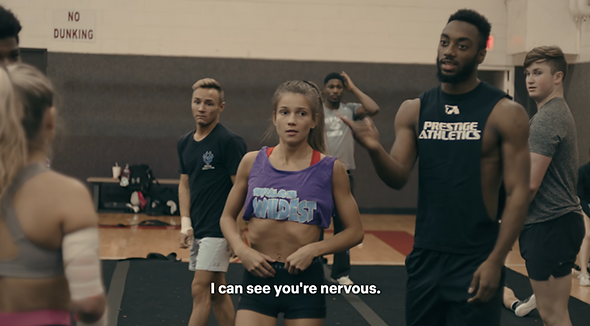
When looking for existing examples in Unit 12, I came across a docuseries on Netflix called Cheer, which is about a cheer team from Navaro College, and it follows them through their training to one big competition. I have watched the first season on it before, but hadn’t seen the second, and I really like how they display their narrative. Below I have explored the way in which the narrative has been displayed in more detail.
Cheer is a docuseries on Netflix which first aired in 2020, which follows the Navaro College cheer team, focusing on their coach Monica Aldama, and multiple other members of the cheer team. Within the first season of the show, the audience follow the team’s journey through practices, competitions, personal life and to the nationals final. As it is a docuseries each episode takes the audience through the process, some episodes focus on individuals, but the audience still follow the timeline of start to finish. When watching through the first season I found that the way the narrative was told and interviews were done really interested me, so I am going to focus in on this within the paragraphs below. The episode I have chosen to explore is the first one of season one, which is titled ‘God Blessed Texas’, this is because in terms of the three-act structure (explored above) act 1 is the setup/beginning which is what this episode is doing. I want to explore how the three-act structure works as well as the way in which this documentary is filmed, such as interviews and following certain people.
From the outset of this docuseries, I can tell that this is an observational documentary. Within the first minute of episode 1 there is use of observational documentary codes + conventions, as the first shot the audience are shown is a handheld pan down, using the convention of Jiggly Camera. There is an element of stabilization within this shot, however you can tell that it is being filmed handheld due to the ‘jiggly’ nature that it has. Along with this, before the audience are shown the shot, so are watching a black screen, there is a voice heard saying ‘You got it, boo. Push through, Push through.’ Then another voice saying ‘five, six, seven, eight. One.’ And as the ‘one’ is said the shot appears. This is an effective use of editing as the audience are brought into the scene slowly, but not too slowly, giving them a chance to understand what’s happening. Also, for the observational mode, the way this is done shows it off because the audience are thrown into the middle of a situation, they have no context or understanding about, they are observing the events being shown to them.
After this, the audience are then thrown into another conversation where the audio of that starts before they see who is saying this. This is the use of a j-cut, as the audio is brought in before the visuals of where the sound originates from (in Unit 8 I undertook research into simple editing techniques and the j-cut is one of the ones which I looked into), it’s an effective but simple technique as the audience can hear someone speaking but are unsure where its come from; leading them to want to continue watching to find out more. Within many documentaries this simple technique is used a lot for the reason just given, it helps to engage the audience keeping the visuals interesting and not boring them. The images below show that the same audio is being said over two shots, image one being the original scene where the voice comes in and shot 2 where the audience are shown who’s saying it.
Shot 1
Shot 2

Another convention used within the first minute is interviews as narration. This is something which continues throughout the rest of the show Cheer, and it’s an effective use of voiceover/interviews to help tell the narrative. Within this opening scene, the audience hear a prominent voice start to speak, but it’s clear it’s a voiceover as the other sounds heard previously are now more muffled, acting as background noise. The shots then continue to focus on one person, the person who’s in the interview/voiceover, once again using the j-cut, to then cut to a shot of the girl the audience had just been shown but now she is in her room talking to the camera. As of this moment I am unsure if the specific style of interview this would be classed as, but I like the use of it. This is shown in the image below.


Throughout the rest of this episode, it follows the same format going from shots of people in the gym rehearsing, to interviews with the interviews acting as voiceover/narration. Its worth noting that these interviews with the cheer team are all done at their homes, in very normal settings which I feel helps to separate the documentary and change the pace with ease. The audience need visual variety, so doing this helps to keep their attention as it changes from shot to shot. Also, the fact that the interviews are done in their own homes/bedrooms helps with the relatability to the audience, because the audience will see that these people don’t live in luxury or are rich, they are normal people like them linking with Dennis McQuail’s uses and gratification theory, this is explored further in the Audience Research Section linked here.
For a first episode, this is effective because the audience are introduced to most of the ‘main characters’, so say, and learn a little bit about them and their lives while continuing to learn about the cheer team and their rigorous rehearsal process, they go through. In terms of the three-act structure, as previously mentioned, this episode is act 1 the setup/beginning, where the audience are being introduced to people and the narrative for the rest of the docuseries, which I feel this episode does well. The observational mode is utilized well as it conforms to the conventions, I explored above in the research section; the audience are shown an insight into these people lives and what they are like in real time. The camera manages to capture moments that are so real and authentic that for the audience its as though they are there watching events unfold, while being assisted by the narration from the interviews.
Even though I have only explored the basis of the first episode above, from watching the series as a whole, I really like how they utilize the interviews to change to different people’s stories/perspectives and how the audience are still able to understand the main narrative as well. As I am creating a short documentary, I can’t incorporate all elements from this series, but I think I will try and use their interview style as a way to explain the narrative.
From watching Dancing the Nutcracker + Cheer, I made the decision to look more into the interview styles/techniques as I was intrigued by the way that interviews were conducted so wanted to understand more.
Interview styles/techniques
(27/2/24)
Within this section, I have explored multiple interview techniques/styles as well as looking into general documentary techniques/tips I have been able to explore from multiple research sources. The first area I chose to research was interview techniques, which has been explored down below.
When it comes to documentaries, the interviews are one of the main elements/convention featured within. However, how these interviews are conducted/structured is different dependent on the interview style. When looking for the interview styles I found that there wasn’t a set number of definitive styles, some research sources would say there are 3, and some that state there are 7 styles. So, for my research, I am going to explore the ones which are the most common/I think I could use within the content of my work. The first area I am going to explore is the 3 main interview styles which are structured, conversational and interrogative, this can be found below.
Structured – this is the more typical style of interview, where it is organised and focused on a set of predetermined closed questions, designed for the subjects to give specific information. There is a very formal tone throughout this interview style as it is used to help move the narrative forward. In terms of advantages, it makes the answers easy to compare as they are asked them in a set order; and there is a better control over the interview as a whole. However, there is limited freedom in what the subjects can say, limiting the natural or authentic feel that some documentaries want to capture.
Conversational – here the style relies on spontaneity, so the complete opposite of the structured style, as they are conducted through open ended questions. This style focuses on the authenticity, through building trust with the interviewee, allowing for more insights to be given in their own words, as well as more candid and expected answers. For this style there is likely to be a set of questions written, like the structured style, however, as mentioned, they will be open ended meaning that the interviewee can say what they want and go off on their own tangents.
Interrogative – for the interrogative style is a lot more formal than structured. Within this style they try to focus more on emphasizing clarity/accountability, they explore more complex issues within narratives and try to get the interviewees to tell the full truth. It requires the interviewer to have an equal balance of empathy to maintain the trust, without accidentally compromises the interview’s integrity. The main technique of this is to use direct address with a set of focused questions, trying to stay on the track of them without diverting.
Though there are the three main styles which I have explained above, from other research sources I have found that there are multiple different styles which are mainly about how the interview is filmed rather than the content of it. I found a practitioner called Mark Bone, who is a Director from Toronto Canada, who produces Youtube videos which help to inform their audience about productions as a whole. In one of his videos, titled ‘Every Interview Style Explained’. He goes through each interview style, including ones which he has used himself within his documentaries, giving examples and explaining with ease about each interview style and how they work. Below you will find the information I have learnt from the video about the different styles of interviews.
Standard -
The standard/structured interview style is your typical interview style which is most commonly used within documentaries. These interviews tend to be very organised and rely heavily on a predetermined set of questions which are there to attain specific information. This helps to ensure that there is a consistency of responses when interviewing multiple people, giving a variety of responses to the same questions. Mainly this is used when there is a more formal feel to the narrative of the documentary, such as an expository doc.
The way in which the subject is filmed is having them sitting and looking just off to the side of the camera. Through putting the interviewer close to the camera, the audience can tell that the interviewee is talking to someone rather than staring straight down the barrel of the camera. Doing this helps for the audience watching to feel at ease because the interviewee is looking off centre, so the audience don’t feel as though they are being spoken to directly. You want the whole face to be captured as well in this style of interview so the audience can fully see who this person is and understand them better.
From the video I found explaining this style, they used their own media as an example of this style which is shown below. As mentioned, the interviewer is sat close to the camera, giving the interviewee/subject someone to look at, so the audience feel more at ease. For this style is works well as the subject is given someone to talk to directly while saying what they want to say. This also helps for the subject to feel more comfortable as they don’t have to worry about looking at the camera they can just focus on the interviewer and speak to them as though they are having a normal conversation.


Using the standard style is the safest option, however it can limit the spontaneity of what the interviewee is saying and have a less natural feel. If the subject/interviewee is comfortable in front of the camera then it could feel more natural, however its highly likely the people being interviewed aren’t sat in front of a camera that often, making it feel more ridged/uneasy.
Interrortron -
This style originated from the director Errol Morris, which is where the subject is sitting, like in the standard style, but rather than their eyeline being off centre to the camera, this time the subject is looking directly into the lens and audience. This is an effective technique to use when the documentary is focused on speaking to the audience and getting them to understand a POV. As the subject is looking directly into the camera, it’s a literal form of direct address, what is being said by the subject is being fed directly to the audience, so they are more likely to believe what's being said. The style got the name as Morris would use a two-way glass, similar to a teleprompter, allowing the subject to see his face over the camera lens, meaning that they look down the lens directly without realising.
As the subject is looking down the lens directly, it would likely fall into the Interrogative style of interview. This is because for the audience it feels as though the subject is directly speaking to them, possibly making it intimidating for the audience to watch. However, if the documentary is focused on more controversial topics, then using this interview style would be effective as the audience are unable to escape it in a sense.
Conversational/In the Moment -
This interview style works through having multiple subjects talking about a certain topic, essentially like a scene from a scripted film. Typically, this style uses two cameras positioned across from each other filming both parts of the conversation. Using this style helps for the interview to have a more natural feel, seeing as though it is just two people having a conversation in real time. Sometimes a single camera is used during this style of interview, so there is use of noddys and extra shots to help when it comes to post-production. Noddys are simply footage of someone gently nodding their head but to no question, I just gives the editor more footage to use and to cut to, meaning the interview isn’t just stuck on someone's face the entire time.
There’s another style called ‘In the Moment’ which is as it sounds. The interviews happen there and then, focusing in on what the subjects are saying. In the existing example I deconstructed this interview style is used a lot as it is of the observational mode. Its an effective way of getting the thoughts and feelings of a subject in a set moment, say right after something big has happened.
As done for the standard style, he used one of his own documentaries as an example, which is called Battleground. In this a single camera was used, allowing him to show the use of extra footage, the images displaying this can be found below. The extra footage is the close-up shot of the guy's hand as this would’ve been filmed after the conversation had finished, due to the fact that there is a single camera being used not two.


Host + Standard -
This style incorporates the standard style, which has been explored above, as it's set up the same but this time there is a counter shot/reverse angle and 2 shot where the interviewer is seen. The use of this style is extremely common in chat shows and celebrity documentaries as usually the interviewer is well known themselves, meaning that having them speak to a celebrity heightens the chances of more personal stories being told, giving the audience what they want to hear. For the audience this also gives context for them to see who they are looking at, rather than just into the void of nothingness. In terms of mode of documentary, this is typically used within participatory and reflexive modes as the filmmaker is featured throughout, so the use of host + standard style works the best.
Voiceover -
The final style of interview within the video watched is called voiceover. Voiceover is generally a convention of documentary anyway, so the voiceover style of interview is just a way that voiceover can be used within a documentary. A point to note about this style is that if a subject doesn’t want to be filmed for an interview but is willing for their voice to be, then this is an effective way of including them. However, this isn’t the only use as sometimes these interviews are also filmed, so the editor could start by showing the subject, but then cut to different shots of them (use of b-roll, actuality and archive) to give the audience some visual variety. Also just watching someone sit and speak because quite visually uninteresting over a long period of time, so voiceover allows for the audience to still follow the story/narrative without becoming disinterested due to the lack of variety.
Through undertaking research into the styles of interview, I have made the creative decision to use the standard style, but with a conversational feel. I want to be able to use the interviews as narration too, so it falls into the voiceover style too. I feel as though with the standard style I will be able to play around more with it and make it what I want it to be and get the information I want to out of them. The interviews are telling the narrative, taking the audience through their story so I want to ensure all elements are captured.
Harvard referencing -
· Bone, M. (2022). Every Interview Style Explained (A documentary masterclass). [online] www.youtube.com. Available at: https://www.youtube.com/watch?v=4E5DkR87SwI.
· www.laivideo.com. (n.d.). Blog: 4 Video Interview Styles | LAI Video. [online] Available at: https://www.laivideo.com/blog/4-video-interview-styles.
· Solberg, S. (n.d.). 7 Steps to shooting cinematic interviews. [online] www.docfilmacademy.com. Available at: https://www.docfilmacademy.com/blog/7-Steps-to-shooting-cinematic-interviews.
· www.youtube.com. (n.d.). How to Shoot a Cinematic Documentary Interview. [online] Available at: https://www.youtube.com/watch?v=W-z8iQ8sQMQ [Accessed 27 Feb. 2024].
· www.youtube.com. (n.d.). DOCUMENTARY FILMMAKING: Interview Styles and Fundamentals. [online] Available at: https://www.youtube.com/watch?v=1N-Yf2p5C9U&t=12s [Accessed 27 Feb. 2024].
· Factual America Podcast. (n.d.). Documentary Interview Styles: Exploring Techniques and Approaches. [online] Available at: https://www.factualamerica.com/filmmaking/documentary-interview-styles.
Additional Content Research
Throughout this project, the research just never ends so within this section you will find the additional research I have undertaken. This research is influenced by a number of factors such as pre-production, legalities, ethics etc. so different area's are likely to be covered. The first area of additional research undertaken was the BBFC Classifications, this is shown below.
BBFC Classification
What is it?
While looking at my production, I have been told it needs to fit into the 12A or below classification from the BBFC (British Board of Film Classification). The BBFC classifies films on behalf of the UK local authorities who license cinemas under the Licensing Act 2003. As mentioned, my production should be either a 12A rating or below, but what is a classification?
From the BBFC website a classification is ‘the process of giving an age rating and content advice to films and other audiovisual content to help children and families choose what's right for them and to avoid what's not.’. These age ratings are decided based on the BBFC’s published, and often updated, guidelines, which are a result of ‘public consultation, research and accumulated experience of BBFC over many years’. The issues that are looked at are things such as bad language, discrimination, dangerous behaviour, drugs, sex, nudity etc. the typical aspects which you would expect to be reviewed when deciding the age rating/classification.
What are the 12A guidelines?
The 12A guidelines mean that no one younger than 12 may see a 12A film in cinema unless accompanied by an adult and no one younger than 12 may rent or buy a 12a rated video. The outlines for a 12A are –
-
Dangerous Behaviour – no promotion of potentially dangerous behaviour which children are likely to copy. No glamorisation of realistic or easily accessible weapons such as knives, no endorsement of anti-social behaviour
-
Discrimination – discriminatory language or behaviour must not be endorsed by the work as a whole. Aggressive discriminatory language or behaviour is unlikely to be acceptable unless clearly condemned.
-
Drugs – misuse of drugs must be infrequent and shouldn’t be glamourised or give detailed instructions on how to do so.
-
Language – there may be moderate bad language. Strong language may be permitted, depending on the manner in which it is used, who is using the language, its frequency within the work as a whole or any other special contextual justification.
-
Nudity – there may be nudity, but in a sexual context it must be brief or discreet.
-
Sex – sexual activity may be briefly and discreetly portrayed. Moderate sex references are permitted, but frequent crude references are unlikely to be acceptable.
-
Sexual Violence and Sexual Threat – there may be verbal references to sexual violence provided they aren’t graphic. The stronger forms of sexual violence, including rape, may only be implied and any sexual threat or abusive behaviour must be brief and negatively presented.
-
Threat and Horror – there may be moderate physical violence and psychological threat and horror sequences. Though some scenes may be disturbing, the overall tone shouldn’t be. Horror sequences should not be frequent of sustained.
-
Violence – there may be moderate violence, but it shouldn’t be dwelled on in detail. There should be no emphasis on injuries or blood, but there can be occasional gory moments if justified by context.
For my piece I don’t think that it crosses any of the guidelines given above. The topic isn’t necessarily focused on any of the above, the only area that may be covered is the language, but this would be mild and likely cut out. So, although these are the guidelines I need to follow, I don’t think my production fits this classification. In the pre-production stage, I have explored what classification my project fits into.