Lara McEvoy - 319311
Unit 13: Final Major Project
Practical skills: Production - 5.1
During the production stage of this project, I undertook multiple roles in order for filming to be completed. The roles undertaken were director, camera operator, cinematographer, lighting technician and sound operator. Each of these have been explored below, click the buttons to go to each section.
Director
(14/3/24 - 4/4/24)
As a director I used multiple skills such as organisation, teamwork and correspondence with contributors. It is important for me to use all these skills to become a good director and achieve the production I want. Below I have explained how these skills have been utilised throughout the production stage.
Organisation - 14/3/24, 25/3/24
Organisation is a skill that I have demonstrated multiple times throughout the pre-production and production stage of this project. In pre-production this included creating multiple production schedules to ensure I knew what was happening as well as cast and crew. For this, I created both a master timetable for myself and crew to use, as an understanding of what is happening and when during the week of show shoots; and I created daily production schedules for each day of the shoots, both show and interviews. The daily schedules can be viewed by clicking the button below which will take you to the production schedule section on the pre-production page.

Another way I used this skill was when I contacted Sally about logistics. As the director it is important for me to contact those involved to ensure the logistics are sorted, hence I got into contact with Sally Prout. In the emails between us I needed to organise the logistics of where Jon would be while helping me film, and who/which dances I am allowed to film. Both of these have been demonstrated in the problem-solving stage, click the button below to go there.
Within the production stage, organisation is a skill that I put to use when it came to making sure Jon knew where he needed to be. For this, Jon needed to know what dances he could and couldn’t film, so to help him, I sent him two documents which had ticks next to the dances he could film. The dances that weren’t ticked he wasn’t allowed to film, and they were colour coded so he could understand which dances he could film in each show. This is shown I the images below.


As a whole I feel the organisation skill is one that I did quite well in, I was able to successfully organise the days of all the shoots with ease. Creating production schedules allowed me to maintain my organisation as I knew where I needed to be, when and what equipment as well. For the role of director, I feel I have been successful with this skill, through the examples given above.
Teamwork - 12/3/24, 25/3/24
Due to the fact that I am in the dance show myself, it meant I had to work with a crew, though be it of one person, but still a crew, nonetheless. The crew I worked with was Jon, one of my peers, and he undertook the role of camera operator. For this I had to use teamwork to collaborate with Jon, telling him where to be, creating production schedules for him to follow/know where he needs to be, as well as sharing my creative vision with him.
As I needed Jon to understand my vision/what I want him to shoot, I showed him a couple of my storyboards, shown below, as this means he can understand what I am thinking. Along with these storyboards, I also spoke to him in person and explained what I was thinking in my head so that he could better understand what it is I want. While I can explain what I want, it's also important to remember that he is just as creative as I am in terms of camera work, so he will be able to get some shots I may not have thought of before.


Along with this, while on the first day of shoot (25/3/24) Jon realised that the telephoto lens was too zoomed in for where he was in the audience, so he messaged me asking for me to bring up the normal lens (shown in the image to the right). This is a good example of team work as I was able to quickly get him what he needed, while I was left with what I needed meaning we could both film at the same time.

So that he knew where he needed to be I showed him the wings (shown in the video to the right), explaining where he can and cannot be. This is important for me to do as he needs to know where it is safe for him to be and so that he doesn’t get in the way of anyone when the show has started. I would say that this was a good example of teamwork because I was ensuring he knew where he needed to be, letting him ask questions as we went along. With this, I knew he would be safe with a briefing of where to go/not go, so I felt I was working with someone safe and someone who would listen to me. The fact Jon listened to me instilled this trust even more allowing us to work well together.
I feel as though there are points, I mentioned during the organisation section that intertwines with the teamwork so this area may feel a little barer than the one above.
Correspondence - 1/4/24
As the director it is my job to correspond with the contributors, ensuring they know where they need to be and when, what they are consenting to and organising shoots. Being able to utilize this skill is vital in creating a successful media product as if there is a lack of communication from the director then people won’t know their role is and what the plans are. An example of me using correspondence effectively was on Monday 1st April.
Monday: 1/4/24
Due to the decision made last week, on Monday I messaged the three asking if they were around this week for the in-home interviews. I had mentioned the interviews at the dance show where the three said they were happy to take part in them so today (Monday 1/4/24) I messaged them asking when would best suit them. I felt letting the decision be made by them was the best decision because I was around all weeks so could organise my plans around filming with them.

As shown in the image on the left, I sent the same initial message to all three and awaited on their responses. Chloe was the first to get back to me, asking if Wednesday would work, which it did, so I mentioned that I would sort timings later as I was wanting to wait for the others to get back to me first. However, as no one else had gotten back to me by 4ish so I asked Chloe whether she would prefer morning or afternoon just so I could gauge if I could fit another interview in within that day. Luckily, she said the morning so we decided to go for 10/10:30ish as I knew it wouldn’t take too long, which worked for both of us.

Ella took a little over a day to respond, as she was busy. But when she did it was a relief to see that she wondered if I was free on Wednesday still, which as I had planned Chloes in the morning it meant I was able to ask if the afternoon was okay with her. As I know Ella quite well, I knew she would be happy for me to let her know when I would come over rather than having a set distinct time the day before. Thankfully this was easy to plan meaning I knew what pre-production work I needed to get done today + Tuesday before filming on Wednesday.


Emily was very flexible with her days that she’s free, which was really useful for me as I knew the others may be tighter. From this I decided that Thursday is likely to be the better day for us to film, as I had already planned in Chloes and was awaiting a response from Ella. You can also see in the image to the right that I asked for a picture of their bedrooms because I needed to complete the risk assessments, it felt quite weird asking but all of them were happy with it, so it made my life very easy. Similarly to Chloe, Emily opted for 10ish to film which worked for me. This means I need to plan in travel time to get to hers and plan in for any issues that may occur while travelling.

Also, I sent over to all three the questions which I would be asking in the interview. Doing this just gives them a heads up and a chance to think through their answers as otherwise I would just be turning up and them having no idea of what is happening, so I would rather than have some sort of idea of what to say/do.

This is a perfect example of me using this skill during production as I discussed with the three when they were around and fitted the filming to their schedules. This helps them to not feel pressured or uncomfortable either as I have let them make the decisions and gone with it.
The role of director is essential in any production, and one of the many roles I undertook during the production stage. For this I had to use multiple skills, which have been explored above. I feel I have used these skills well and to the best of my ability to undertake this role.
The next role I am exploring is Camera operator. While I had Jon to help me for the show shoots, I still got footage on those days as well as shooting the interviews alone.
Camera Operator/Cinematographer
The camera operator is in charge of lots of different things, such as, setting up shots, managing/operating the camera, checking ISO/Apature etc. As I have been using cameras for a long time over this course, this role is one I am a lot more confident undertaking, as I feel I have the skills to do this. With this, there is also the role of Cinematographer which isn’t the person setting up the shot (the camera operator), this is the person who’s telling the camera operator what they want in the shot/how it looks. Seeing as I am acting as a 1-person crew for the majority of this, I am both these roles. Below I have explored how my operation of the camera was used in the different areas.
Setting up the shot/framing: 25 - 27/3/24 + 3 - 4/4/24
Throughout the entire production stage, I set up multiple shots, all different shot types and with different purposes, such as b-roll, actuality and interview footage. With the interview shots, these took more time to set up and think about what was going to be positioned within the frame, as these were static shots, and the main shots for the whole interview so they needed to be right. As the interview shots are the only shots of the interviewees, I took into consideration what would be positioned within the frame and how the interviewees themselves would be positioned within the frame.
When setting up the main shot, shown below, I was wanting the camera to be positioned so that it isn’t either look up at her or down on her as those both give off the wrong feeling and look, I was wanting to achieve. I was able to set it up so that she is centred, with equal space either side of her, allowing for the audience to see a little bit about who she is as a person rather than just having her defined by what I had filmed at the dance show. Doing this shows I have taken into consideration mise-en-scene and undertaken the role of cinematographer quite well.


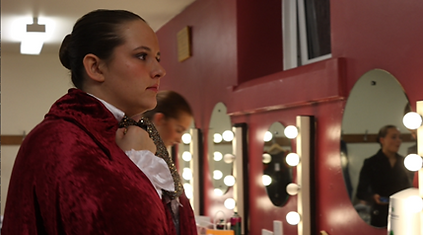
With the b-roll/actuality footage it was more in the moment, free hand and movement based as it is an observational documentary, so I am conforming to documentary conventions while doing this. This is a skill a cinematographer would take into consideration because they understand the conventions so want to use these, while keeping the footage more aesthetically pleasing. The images below are some examples of the framing of the shots I got. These are all examples of the in the moment footage, so in terms of a cinematographer it isn’t technically set as certain shots, it's what I could capture there and then. Though I have done this, I still used the skill of framing to make the shots look visually easy on the eye, specifically the top right one. You can see how I have positioned Ella on the left of the frame, showing the mirrors on the right of the frame, telling the audience that that’s what Ella is looking into to see what she’s doing, and revealing more of the behind-the-scenes aesthetic.



Focus: 25 - 27/3/24 + 3 - 4/4/24
While framing and setting up the shot are important, you also need to ensure these shots are in focus. Focus is vital for a shot to look good, and it helps to direct the audience's attention. For the interview shots, I needed the interviewees to be in focus as if they aren’t, then that’s the main shot for the interviews and it just wouldn’t be visually interesting or good, I know I would end up not using the footage and just the audio with b-roll over the top, which I don’t want to do.
To avoid this happening, when I was setting up the shots, I used manual focus and took the shots completely out of focus and then slowly pulled the focus until I could tell the interviewee was definitely in focus. From this I could ensure that they were in focus, without the background being blurred too, allowing them to be the focal point of the shot but the background to still be seen.


When it came to the b-roll/actuality the focus was certainly an issue, but mainly when shooting in the dark. This is because as the monitor isn’t that bright and when the area, you’re it doesn’t have much light; it can be extremely hard to tell if it’s in focus or not. As a result of this it meant that at times auto focus was used to capture necessary footage, however manual focus allowed me to focus on certain people more easily. Pulling focus is such a skill itself that when shooting b-roll I took my time to pull it as I didn’t want to get footage that wasn’t in focus, but at the same time I didn’t want to miss the action from pulling the focus. But overall, I would say that my focus throughout the b-roll/actuality I shot was mostly in focus, some shots were a bit soft, but this skill was one of the stronger suits for this project.
White Balance: 25 - 27/3/24 + 3 - 4/4/24
White balance is a simple but effective skill used by the camera operator. When setting the white balance, what you are doing is telling the camera what white is and that it should set the shot to comply with this. With white balance, if it isn’t set correctly then your shot will likely look a weird yellow, green, orange colour rather than what the human eye is seeing in real life. To set white balance there are multiple ways of doing this, such as using pre-sets or manually yourself, now this is dependent on the setting of the shoot.
As I have talked about within the other two skills for the camera operator, the white balance is also dependent on the footage you are shooting. So, for the interviews I set the white balance manually through taking a photo of a white piece of paper/card in the frame, once the shot was set up to how I wanted it to be. Then I made sure that the camera was set onto the custom white balance setting and used that photo as my reference. This then meant the frame didn’t look an off-white colour. Whereas with the b-roll/actuality I used a pre-set, specifically auto-balance. This was done because the nature of the footage, the lighting was constantly changing so using manual white balance would’ve taken up too much time.
Overall, I would say the role of camera operator and cinematographer were successful. I have clearly demonstrated my ability to operate a camera and understand its functions, while taking into consideration framing, mise-en-scene, composition etc. While the camera operator role is successful, for the shot to look as good as it did, I had to also undertake the role of lighting technician to ensure the shots looked aesthetically pleasing and not too dark.
Lighting Technician
(3 - 4/4/24)
Another role I had to undertake was the role of a lighting technician where I attempted to use the skill of three-point lighting. I say attempted because I only had one light, due to there not being enough lights at college for me to take out more than one of them. So, because of this it meant I had one light and I had to use natural lighting to the best of my ability.
One of the shots where this skill is best used is Ella’s interview shot, shown below. As you can see there is natural light coming from the window on frame left, so there should be a shadow on the right of the frame, but through using the standing light as the key light I have been able to eliminate this factor. Because I didn’t have 3 lights, I feel that this actually shows more skill than three-point lighting as while it’s still a tricky skill to use, as I had to adapt to the situation and still get an aesthetically pleasing shot which works really well. The lighting looks natural it doesn’t look as though I have just chucked a light into it because I was told to. I have been able to carefully adjust the lighting to the correct settings to create the calm and light aesthetic, eliminating the shadows without it being too harsh. I feel I was successful in the placement of the lighting as in the shot, it looks natural it doesn’t look as though there is a standing light there which is what I was wanting to achieve.


Overall, I would say the role of camera operator and cinematographer were successful. I have clearly demonstrated my ability to operate a camera and understand its functions, while taking into consideration framing, mise-en-scene, composition etc. While the camera operator role is successful, for the shot to look as good as it did, I had to also undertake the role of lighting technician to ensure the shots looked aesthetically pleasing and not too dark.
Sound Operator
(3 - 4/4/24)

The final role I undertook during the production stage was the role of the sound operator, and admittedly this is a role and skillset I wasn’t as confident with. For this the main skill I used was the use of radio microphones and setting them up with the camera.
Each of the interview shoots was done the same with sound. I put the receiver onto the camera and put the microphone on the interviewee. Once the mic pack was on and in the right place, I put my headphones on to check that it sounded okay and that nothing was knocking the mic and causing interference. This was easy enough to do and I was able to make sure that the interviewee could be heard clearly, however on Ella’s shoot I had an issue with this job role. Midway through filming I hadn’t put the headphones on for a while (other than checking at the start) when I noticed that the screen on the receiver wasn’t on, therefore meaning that sound hadn’t been recording. Essentially a very big problem. Once I had noticed I immediately put the headphones on and realised that there was no sound recording, so turned it back on where the audio kicked in. Because of this I then went through the footage to see how many shots I had done without there being any audio and it turned out there were 3, 3 of which Ella had spoken a lot in but luckily as I noticed this, we were able to re-shoot them there and then. As I explained the issue to Ella she said if that when I got home and noticed any major issues, if she needed me to, we could reshoot it.
Seeing as I made this mistake, at the next shoot I made sure to keep the headphones on while filming and made sure the viewfinder on the microphone was always on as that meant it was still on/recording. This mistake really reminded me that this skill isn’t my strong suit and I had pretty much dismissed the sound for Ella’s shoot, which I shouldn’t have done. While this skill isn’t one which was done with 100% accuracy I still used it to the best of my ability and in the end, I got usable footage with good audio which isn’t peaking or muffled, so I am happy with how this role went.
Sound operator is certainly one of the roles which wasn’t undertaken as well. I made some mistakes, and I am aware of these, and annoyed I let them happen, but I was still able to get some really good audio, so I am as happy as I can be with that. While I don’t have all of the audio, I wanted what I got is clear and there isn’t any interference.
In the next section I explore the use of skills in post-production, this can be viewed by clicking the button below.