Lara McEvoy - 319311
Unit 13: Final Major Project
Over the past 16 weeks I have been working on this project and it’s safe to say that it’s been tough but so worth it. In this final evaluation I am going to be reflecting on the project as a whole, and even the impact of previous units. This has meant so much to me, creating a project about something I hold very close to my heart, and it has truly allowed me to develop as a media practitioner, which I am extremely grateful for.
Before I can go into talking about this project, I am going to be reflecting on Unit 12, which was my specialist study and the impact it has had on this project.
Impact of Specialist Study
Unit 12 was primarily focused on researching a topic in great detail, which linked with the main idea for my FMP. From this I had to make the decision on what I researched, as I knew I wanted to create a dance documentary so I was limited to what I could research. I had debated whether I researched into dance documentaries specifically, which would allow me to explore the different codes and conventions, theories etc which would link in with this specific documentary; however I realised that I have never actually made a documentary before, so I should probably write the specialist study on something more relevant, which is how I ended up writing about ‘how documentaries have developed overtime to tell a convincing story’. I chose to look into this as this would allow me to gain a basic understanding of the history of documentaries, while learning about the relevant theories, with the hopes that this would give me a good grounding ready for Unit 13.
Within the specialist study I really delved into the ins and outs, exploring the history alongside practitioners giving me the chance to understand how documentaries truly work and how the modes are conveyed to an audience. But most importantly, as the title of the study suggest, I was able to understand how to tell a convincing story within documentary, which was beneficial for me within this project as a whole. However, I should start at the beginning on how this specialist study influenced this project.
Ideas development is the first stage of this project and the first stage where Unit 12 came into play. To start off I began with creating a mind map with multiple different ideas for different mediums of media because even though deep down I knew I wanted to create a documentary, I had to explore other possibilities. From this mind-map, I immediately made the decision to use documentary as my chosen medium for this final project, due to the research undertaken in Unit 12. I felt this was the best option as I knew what I needed to do in order to tell a story within documentary, however I was lacking in knowledge for actually producing one, but this was something that excited me at the same time. As I knew what elements were needed for the story aspect but not how to actually produce/develop a documentary, I felt it was an ambitious decision to make, more so a challenge than anything but a welcomed one.
The whole specialist study has so much value to it, which was extremely useful throughout the first few stages of Unit 13, however I would say that looking into Bill Nichols was the most valuable, specifically the 6 modes of documentary. This holds the most value to me as within this area of the specialist study I could really see what each mode meant, exploring how they work, how an audience would react to it, does it meet their needs, what’s needed for each mode to make it unique etc. I found that exploring this within the study allowed me to take my time and fully understand each mode, ultimately this led me to look into observational vs hybrid which solidified my decision in Unit 13 to use the observational mode of documentary. It’s worth noting that throughout the entire specialist study I had the thought in the back of my mind that I was wanting to produce an observational documentary so through exploring Bill Nichols and observational vs hybrid I was really able to solidify this decision, leading to Unit 13 being influenced the way it was.
Although my specialist study was extremely influential to Unit 13, I do wish I had been able to explore more than one media practitioner in depth. I feel that if I was able to look at one other then I could make comparisons between the two to see how they produce their documentaries, leading me to understand how I could better produce my own. As I only looked into Nick Broomfield, it meant I only really understood how he tells the story within his own documentary style, which was extremely useful for me, I was then left with only one understanding of how I could do this. If I were to look at another practitioner such as Louis Theroux or Micheal Moore, I may have been able to see other ways in which the story is told to an audience and use this in my work.
To conclude, my specialist study was extremely useful for Unit 13. It really allowed me to understand how documentary works, more specifically how I should display a narrative so that an audience can understand the message. I could see how current media practitioners are displaying their narratives, while understanding the history to see how far these documentaries have come. This gave me a solid base for Unit 13, meaning I only had to do some additional research within the unit, so I could be as confident as possible with telling a story in the chosen mode.
My Intentions
From the start of second year, I knew that the time when this project was running, the dance school I attend would be putting on their bi-annual dance show which holds a very special place in my heart. As I knew this, I didn’t want to push the show to the side and not do it because it was running at the same time as this project, which influenced my original intentions to create a piece of media which was focused on the dance show or the Sally Prout School of Dancing. Due to the nature of my intention, the medium used would-be documentary, as I felt that this would be the best way to display the intention and I would be able to explore the use of narrative alongside it. The potential ideas for this documentary were explored further in the initial ideas stage of this project, LO1 1.1, as I was set on using this medium after looking into a couple of others. This was effective as it allowed me to see which ideas I had the most thought on, so that I could then make a logical decision on which idea to go for. But in all honesty, while this additional ideal development was useful for me to explore other potential ideas, in case my initial intentions didn’t work out, I knew what I wanted to create from the start of the year and that was where my heart was set.

Click on the image above to view the mind-map in more detail, or click the link below:
The main focus of my idea was a documentary which tells the story of the days of the dance show, and potentially focus on the three or more of the pupils at the dance school. I wanted to do this as a way to show how the show is for the people within the dance school, the pressure of it, the excitement, enjoyment, the friendships made etc. as this is what I have grown up knowing and I wanted to show this to a wider audience. Along with this, as this is the year that myself and may of the other girls are leaving, I thought that creating this would give them something to look back on in the future, something I know I would like so thought the same for the others. Focusing on the actual days of the dance show would mean I would be able to get lots of footage from both under the stage and from the audience perspective, giving the intended audience a new perspective of the show, quite literally.
While creating this idea would allow me to have something to look back on, I also noticed the importance of this idea it being something which is extremely creatively challenging for me. With this idea I would need to push myself a lot as the structure was likely to come together while filming and during post-production, due to the idea being an observational documentary. The observation mode is heavily reliant on a rough idea of how the events being recorded will unfold, however nothing ever goes to plan, so I knew I needed to be ready at any point during the 4 days of shoots, something I wasn’t used to. Throughout the whole course I have been used to setting up a shot and doing multiple takes, but with the chosen medium and mode, this isn’t something I would be able to do – other than for the interviews at home – instead I would have to conform to documentary conventions and get used to the free hand, not set up shots.
Another reason I had to make this specific idea was that throughout the past two years on this course, I have found that when producing pieces of media if it’s something I am invested in or have a connection to, I am more likely to want to make it. This leads to me producing something I am proud of because I have wanted to make it and wanted to produce it to as high a standard as possible. As I have been at the dance school for 16 years and have taken part in every show, I knew that producing a dance show documentary was a good idea and I would produce something of high quality because it is something I hold so close to my heart. I wanted to produce something I would be proud of, and I knew this would be achieved from focusing on the dance show.
To go with this, while I would be working with people I knew and are close to, I was also going to pushed out of my comfort zone. Being pushed out of my comfort zone is something I am going to have to get used to for my future career, particularly as I have chosen to go into TV & Radio Production. I hoped that producing my initial idea would give me more confidence to work within real world situations, not on a set that I have organised and set up myself. I had to adapt and get used to filming with people in the moment, which was awkward to start with but after the first day I was more comfortable doing. This also shows I made the right decision when choosing the idea and to go with my original intentions.
When it comes to what I was wanting to achieve from my initial idea, the idea that I produced, I wanted to create an inspiring documentary that parents and pupils could watch to show the journey some of the older girls have gone through, and that they may potentially go through in the future. I wanted to achieve this because I know when I was younger, I always looked up to the older girls during the shows, I aspired to be like them, I wanted to do what they did, and this is a feeling which is reciprocated by current pupils at the school; so through producing a documentary which reflects on their journey from where they started, compared to now when they are leaving, it will give the younger pupils of the show that insight into what their future holds. With this I will mention that the younger pupils may not necessarily watch the documentary, however the parents will be likely to watch it so they can see this, which for them may be something that they want to see as it shows what their child could be doing in the future.
In order for me to see if I have achieved this, I created a survey for the dance school which Sally Prout sent out to the whole school, as this would allow me to gain feedback from the intended audience. Within this survey I included the entire documentary, with follow up questions which included both qualitative and quantitative questions, as this allows me to get answers that I can look in to, to see if I have achieved my intentions. From looking at the survey I have been able to pick out a couple of different comments made which show I have achieved what I had aimed to do.
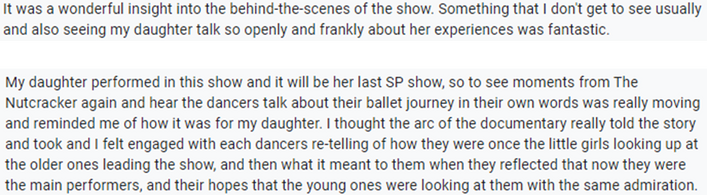
The first qualitative question I asked was ‘why did/didn’t you enjoy the documentary?’ which I got a few comments about how their children were in the show and it was ‘a wonderful insight into the behind the scenes’. Along with this there were two comments made from parents who have children which this show was their last, these mentioned that ‘seeing my daughter talk so openly and frankly about her experiences was fantastic’ and ‘I felt engaged with each dancers re-telling of how they were once the little girls looking up at the older ones leading the show, and then what it meant to them when they reflected that now they were the main performers’. Both these comments show that I was able to achieve what I was hoping for, as I mentioned previously, I looked up to the older pupils and I was hoping that this documentary would do the same, and these comments show that.
However, the main comment that shows I was able to achieve what I intended was from another question, which was ‘did you have an emotional response to the documentary? If so which part?’. From this question I had one specific response which really proved I had achieved one of the intentions, the response stated that ‘My 5-year-old was in the show and seeing the girls speak up about their journeys made me think about how her journey is just beginning and where she could end up’. This whole comment proves I was successful in achieving my aim, the parent has stated the aim I was wanting to achieve, which is amazing. I am so proud that I have been able to achieve this and getting this response from an anonymous parent who I don’t know really shows I have done this without them knowing the idea/development the documentary has gone through.

For the older pupils at the dance school, I wanted to produce something that they can look back on and reflect on their journey. As I experienced it myself, I know that there were a lot of emotions at the show seeing as it was the last time we would all be together dancing on that stage together, giving them something to reflect on other than the show recording is a lovely thing to do. All of the older pupils have a strong emotional attachment to the shows, so even though some of them aren’t the focus of the documentary, I hope that they will still enjoy it and relive the experience.
I was able to know if I achieved this through the same way that I knew I achieved the previous intention. For this one I got a lot of responses from multiple different questions such as, ‘brings back all the feelings and emotions’, ‘it felt like I was back under the stage’, ‘I cried because of how relatable it was’, ‘reminded me of when I used to dance and the enjoyment from it’, brought back memories of my own dance shows years ago’ and a final comment I got form a past pupil which really stuck with me was ‘it literally made me cry and miss everyone so much!’. All of these comments are proof that I was able to achieve what I intended. I have given them something to reflect on and I can see that they appreciate that from the comments stated above.

Overall, I would say that from the initial ideas stage to gaining feedback from the parents/audience, I can see how my intentions have developed overtime and were achieved. I am proud that I was able to carry through with my original idea and produce something I am proud of, achieving what I intended on from the very start.
Problem Solving
Problem solving is a huge part of this entire process as problems are always going to occur, if they don’t then that’s very impressive. For myself, I had my fair share of problems, though when I had to think about them now, I struggled to find specifics due to how many little problems I ran into. However, I have been able to break these problems down into 5 sections: creative, logistical, technical, project management and emotional. Each of these areas have multiple different problems which I have explored in more detail throughout this section, starting with the creative problems.
Creative Problems -
Problem solving is a huge part of this entire process as problems are always going to occur, if they don’t then that’s very
In terms of creative problems I faced, there were a couple that stood out a lot more than others, the main ones being the structure of the documentary and interviews. Both of these problems continued throughout the pre-production, production and post-production stages. The first creative problem I am going to discuss is the structure of the documentary.
During the initial ideas stage, I found that I could never really picture the structure or even figure it out in my head. The main reason for this is the fact that it’s in the observational mode, so I am reliant on the filming to form the structure however I needed to have some sort of an idea of the structure before I went to film, so I knew what it was I needed to film. The first way that I tried to overcome this problem was within the chosen ideas section of the project, I created a mind-map which details the content that would be focused on within the documentary. As shown in the image below, the content I wanted to include was mostly side of stage shots, at home interviews, in person interviews during the shows etc. This slightly helped with the structure of the documentary however it didn’t detail exactly what the structure is, just a rough idea of the content. I had hoped making this would help guide me to structure it as I thought if knew the types of content I wanted involved, the structure would come to me but that wasn’t the case at all.

The second and third ways I tried to overcome this was still in the initial ideas stage, I created a timeline for the documentary and a structure of documentary logic chart. The timeline was made so I could lay out the entire documentary from start to finish, where I hoped I would be able to note down how I thought the introduction, scene 1, 2, 3 and the ending would go (shown below). Within this timeline I began to think about how I could use interviews as narration, but not in home interviews, I would use in the moment interviews. I had thought to use these as a guide for the structure because I gathered this would make the structure easier for me in post-production, but while I could write down ‘use in the moment interviews’ I genuinely was stumped. I think this shows how I knew what I wanted to create, but I personally am not that creative when I don’t have material to work with. On the last FMP I created a music video, so I knew what the structure would have to follow, I created a narrative around the basis of the song, whereas now, I am making something completely different and from scratch; and I think that’s where the issue lies. I am so reliant on using something as a guide to help me create the structure, so when I had to genuinely think about it and create it from nothing, I struggled a lot.

Click on the image above to view the mind-map in more detail, or click the link below:
As I mentioned in the previously, I also created a logic chart in an attempt to help me solve the issue of the structure. While I thought this would once again solve the problem, what I found it did was just create another list of the potential content which would be featured, but unlike the timeline, I split it out completely into the introduction, show footage, interviews, the narrative and the end of the documentary. This meant I could really think about how this would start and how it would end, and the specifics of the footage I want to get. I will say, this did help me quite a bit in terms of the use of interviews, though this was another creative problem I faced, this could structure it, I would just need to figure out what questions to ask the three if I were to do both the in person and in home interviews.

Click on the image above to view the mind-map in more detail, or click the link below:
Due to the attempts to overcome this problem in initial ideas, I decided to move onto the pre-production and see if I could figure it out here. The way that I tried to figure this out was through creating a concept outline. A concept outline is where you write down rough notes on what’s going to happen within the documentary, with some timescales so I can better understand the structure. With this, I found that it was starting the structure is where I struggled as I couldn’t get it started, well the main bulk of the documentary after the introduction. With this concept outline I found that I was able to get I done, but the structure felt very repetitive and the same, which didn’t fill me with confidence. I felt that it would be very boring and not engaging for an audience to watch, there’s a high chance that was because I knew I was unsure of what footage I would exactly get, so was unsure how this would work out. The concept outline can be seen below.

I do feel that this concept outline certainly helped me to understand the structure better, but the problem still hadn’t been solved. It wasn’t until I had finished filming the show days and decided to film in home interviews that the issue of the structure occurred to me again. I decided to undertake in home interviews as during the show shoots, I was unable to actually do in the moment interviews as both myself and the other three were busy with ensuring we were on stage at the right time/helping others too. From this I knew I needed questions to ask the three during these interviews, which in turn helped me to create a sort of structure to the documentary. For the questions I did have to ask a peer to help me out because I was unsure on what I could ask, but once I was in a flow and understood what it was, I wanted to know it was easy enough. These questions are shown below.

These questions really helped me to solve part of the problem at hand, particularly once I had filmed the interviews as the three had answered the questions and with logging I could make links between the answers. Once logging was done, I found the main way that this problem was solved, was through editing the interviews together and closely intercutting what the three had said. With this I was able to edit together the structure with ease, though it took a very long time. This is something I gathered would happen earlier on, I knew that once I got to post-production, I would be able to piece it together and I could see what footage I had, what the three said and how that could all link together. As I mentioned earlier, I feel this creative problem occurred as I didn’t have any content to work with, I didn’t have a guide to use, so I struggled to come up with a way to structure it. The videos on the right are timelapses of me intercutting and interviews together to get the structure.
In the introduction I mentioned how I also struggled with interviews; however, this has been covered within the exploration of the structure problem. The interviews were more of a debate whether I did them or not, I knew the style I wanted to go for, but it was a case of if I did them or not. As I said above, I decided to do them as a consequence of there being a lack of interviews done during pervious shoots. So, this wasn’t a creative problem, it was more a logistical one, but not a big one.
The next problems I am going to explore are the logistical ones.
Logistical Problems -
With the logistical problems I found that they were mainly centred around one element, which was Sally Prout. This is probably going to sound bad, but she was the reason for nearly all of my logistical problems, but for some of the problems I can understand why she caused them/brought them to my attention. The main logistical problems I faced because of this was consent, filming and who I was allowed to film.
For this project I knew I was going to have issues regarding consent, especially with me filming pupils from the dance school. The first problem I tackled with Sally was the consent for the filming of the show itself. This problem was caused because Sally said that for her and the company’s protection, it would be easier for me to just film the older dances/the dances that only the 3 girls are in. This wasn’t something I had expected to encounter because with the dance show, it’s filmed by an external company which the parents can then either buy or download to watch it. For this I know my parents had to sign a consent for that Sally sent out, stating that they were happy for me to be filmed for this, so I know that everyone in the show has given consent for this otherwise they aren’t in the show. Because of this, I was thought that I would only need Sally’s consent for the filming of my documentary as she would be acting as locus parentis for the pupils while the show is happening, but I was wrong. Well, I wasn’t wrong, I was right technically, but Sally wasn’t comfortable with us doing it like that as she is unsure how some of the parents of the younger pupils would react. This was something which we discussed in class, but she told me to email her with more details which is where we started to resolve this problem.
In the email conversation below, you can see that I asked her what she was wanting to do in terms of consent, as I was unsure whether she was wanting to have written consent for everyone or if she had thought of another way around it. From this she responded asking for me to produce a form explaining what it is I needed consent for and that if we didn’t hear anything by a certain date, we are to assume that it’s okay for their child to be filmed. As this was the route Sally wanted to take, I checked with one of my lectures if this was okay, and it was, I just needed to be aware that no one gave set consent so some people could have issues with it potentially. However, I didn’t have any emails from any parents stating that they aren’t happy with it so that was all okay. This logistical problem was a simple one to solve, but one I hadn’t entirely anticipated, a solution was found quite easily, and I was able to collaborate with Sally to find a solution.


Another logistical problem I encountered with Sally was the agreed filming days/arrangements. I had emailed Sally the day before the first shoot to double check that our previously agreed arrangements were still in place. From my side I hadn’t heard anything before me emailing about the agreements being an issue, as Jon would be in the wings during the actual shows but out of the way, so I could get footage from the wings, but after I emailed her, I got a response I didn’t expect. The photo below is the email I received.

In this email she stated that she would rather Jon only be there for the dress rehearsal and one of the show days. This threw a massive spanner in the works for me as it just led to me panicking about the documentary and throwing me off. I had previously agreed with her to have Jon around for the dress rehearsal, show 1 + 2, which she had agreed with before but then she had clearly changed her mind. I wish she would’ve let me know sooner as then I could’ve adapted to the change sooner, but as I found out the day before the first shoot I panicked. This sent me into a spiral of if I change the entire structure of the documentary, do I change the mode, am I in the documentary and so on. This panic was purely stress induced and I soon came to the realization that this could actually work out for me. I could still go with the original structure, but now I would just have to do the in-home interviews as I knew I wouldn’t have enough content from the shows now that I am down a show that can be filmed from the wings.
Having this problem was entirely more stressful than it needed to be. I was able to overcome this panic pretty quickly, but it still threw a logistical problem in the works. I had planned out these shoots in detail, as shown in my pre-production, so having this suddenly thrown away created a logistical problem for me structurally. However, it did mean I had to make both a creative and a logistical decision to undertake the interviews, which actually worked out for the better.
The final logistical problem I encountered is related to the consent issue discussed earlier. During the interviews Ella mentioned how during the dress rehearsal she messed up the magic tricks, and luckily, I had some footage of this happening which I could pair with it for actuality. However, within this shot there were 5 pupils of the dance school who hadn’t given consent and are under 18. So, in order to overcome this being a problem, I made the logical decision to blur out their faces. This was a simple task to do, creating a simple solution to a potentially wider problem. I felt that this was the safest thing to do, while it doesn’t look aesthetically pleasing, it means I have conformed to the consent guidelines and respected the privacy of those who hadn’t given consent.

Before

After
As a whole the logistical problems faced weren’t too big and they were all resolved with ease. I realise a couple of the problems were all caused by the same person, but each of these problems are understandable. She doesn’t want to upset any parents or bring any problems/have repercussions to the dance school, so the decisions made were more for her benefit than mine. Though I am happy I was able to collaborate with her easily.
The next area of problems I am going to look into are the technical problems.
Technical Problems -
Technical problems are related to the literal technical aspects of the production. This section won’t be as large as the previous two as there weren’t as many problems that occurred here. The main technical problems I faced were the microphones not working and not being able to do 3-point lighting.
During one of the shoots the receiver of the microphones decided to turn off randomly. This isn’t something I noticed until we had shot 3 big questions, it was only when I looked and saw that the screen on the receiver turned off. To start with I wasn’t sure if this was something that was normal, but I know that this didn’t happen with Chloes interview, so I put the headphones on and to no surprise there was no sound. Because of this I pushed the power button on the receiver, with the headphones on, and as soon as I hit the button the sound returned. From this I was unsure for how long the receiver had been off for, so I had to go back and check over all the footage to find exactly where it was that the receiver first stopped working. Unfortunately for me it turned out the past three questions/clips had no audio, at all. So, I re-recorded them as soon as I had worked out where we got to with the questions.
This problem was very quickly solved, but it could’ve been very easily avoided as well. I am still unsure how this issue occurred as I knew I checked all of the equipment when setting up the shoot, ensuring everything worked. The only plausible reason I can think of for this is that I went back to check how a previous shot looked as I was adjusting the lighting/curtain placement that it turned off there, but I still don’t see why the radio microphones would have this feature.
The second technical problem I faced was in relation to 3-point lighting, specifically the fact that I couldn’t book out 3 lights from college. In college we have been taught how to set up and use three-point lighting, I even did further research into this during the production process research page. I did this research as I was under the impression we would be allowed to take out three lights or even 2, but when it came to booking out equipment the whole class were told we could only book out 1 light per person. Now 1 light certainly doesn’t do the job of the three-point lighting technique, so as a result of this I had to adapt and work out how I could utilise this the best. The way I solved this problem was to use natural lighting as my fill light/back light and the standing light as my key light, the best example of this is in Ella’s interview.

The image above is Ella’s interview setup, where I have detailed where the fill light is and where the key light is. The fill light is the natural light from her window as where I positioned the camera it worked out quite well. As I have the fill light on the left, I positioned the key light to the right as this side of the room was quite dark due to the window. With the key light, as it’s an artificial light source I had to make it look as natural as possible, so I used a more yellowish light, which worked out really well. This image shows how I was able to overcome the problem of only having one light, I used the other resources I had available and adapted to the situation, proving I could still use three-point lighting, without having three artificial lights.
Both these technical problems were quite simple to solve but still problems I encountered, and ones which required immediate action, not just ones which I could solve overtime. I feel the microphone problem could’ve been easily avoided if I kept the headphones on for the whole shoot and not taken them off once I had set up. The impact of these problems were more annoying than anything else, especially the microphones as I knew Ella said so much good stuff when the microphone decided to not work, so when we re-shot it she couldn’t remember what she said.
Project Management Problems -
The next set of problems I am going to evaluate are project management. Project management problems are about the issues I faced as the producer of the project, which for me was mainly about sending out and getting forms back in time for shoots. With any production there is a lot of logistical pre-production which needs to be completed before going out on a shoot is allowed, which includes consent forms, location release, risk + location assessments. Each of these forms needs to be completed but for myself, I found that I was able to do my role quite well and get the forms sent out with enough time for them to be completed, however it was a case of getting them back which was the main issue.
The first form I needed to be returned to me was the consent forms, which wasn’t too big of an issue, only Chloe took a while to get back. So I could make sure that everyone got the consent forms, I messaged them and asked for their emails as this was a simple way to ensure they got the correct form and in the correct format. Once the emails were sent out, I found that after a couple of days I hadn’t had a response from both Emily and Chloe, which wasn’t a huge issue, but I was very aware that the days of the shoots were getting closer and closer. Luckily after I had sent them a reminder message, they got them back to me within the day. This part of the problem was simple to solve but the location release forms were a bigger issue.
With the location release forms, I send them out the day before the shoot as I thought that this would give them more than enough time to get them back or even print them off to give to me in person, however I found that only Emily gave me the form in person. This was useful as I could then take a photo of it for my keeping. With Chloe and Ella, it took a couple of weeks to get them back to me. This was because Chloe’s mum forgot to send the form back over until I messaged and asked, where she sent it over immediately. But with Ella, the issue was that her mum’s emails stopped working and she couldn’t send it over to me and got busy with work, which is understandable, so Ella then printed it out and gave it to me in person a couple weeks after the shoot had happened.
This is a reflection of poor project management from myself as I should’ve given these out more in advance, but also having them sent back to me wasn’t up to me it was up to those signing them. The problem here was both one I caused myself, and one caused by the contributors as they didn’t get them back to me when I had asked. In hindsight I probably should’ve taken a form in person so that if they hadn’t replied with it I could’ve had them sign it there and then.
The final set of problems to discuss are the emotional problems faced.
Emotional Problems -
Throughout the whole project there were many ups and downs which I delt with in different ways. I found that there were times where I wasn’t able to control my emotions and just broke down after being at college, but there was one time where I felt at a real low and this was when Sally said she wanted to change the days where Jon was able to help me film. I probably overreacted here but I was so stressed about both the project and the show itself that I just broke down. I was so unsure on what to do and how I would overcome this change that I panicked about the mode of documentary, did I now include myself within it, how would I get enough content etc. which now looking back I didn’t need to panic as much as I did because two days of footage was more than enough.
Over the course of the 16 weeks, I feel I managed my time well as I was organised and focused on working to schedule. There were times where I had to adapt my original schedule, but this was due to me being too ambitious during the planning stage. Once these changes had been made, I found that I actually worked at a sensible pace throughout the project. I left myself with enough time to get work done and ensured that work was done by a certain deadline that I would set myself, as I found that this was the best way for me to get the work done. If I weren’t to set myself deadlines, then the work wouldn’t have been done at all in all honesty. I would’ve lacked a lot of motivation and drive if I didn’t focus and keep my deadlines in mind, so I am grateful I did that.
While I said that this project had its ups and downs, I do have to say that this FMP was a lot less stressful than FMP 1, which was really weird to me. From the start of the project I felt a lot more relaxed and as though this wasn’t actually my FMP 2, I just got into the flow of it. I think the reason for this is that I knew what I was doing. During FMP 1 I had a basic understanding of what needed to be done but was unsure on it and didn’t really get timescales, meaning I didn’t allow myself enough time to get work done and really stressed myself out about it. Whereas with this FMP I have found I was a lot calmer due to this extra year of practice and knowing how long tasks would take.
No project undertaken won’t have an emotional toll on you, if it does then I applaud you. I found that the times where I was more emotional or stressed was when I encountered issues related to the show itself and filming, because it’s something close to my heart. Focusing this project on something so close to my heart was something I am glad I did. It meant I was really emotionally invested in this project, pushing me to work as hard as I could, and I’m proud of that. I am so happy with how this project has turned out and the journey I have gone through was worth it.
The Effect of Creative Changes -
In each stage of this project there have been creative changes made that allowed me to adapt my piece to become what it is today. The first creative changes made were during the research stage of this project, where I was able to adapt the proposed idea as a consequence.
With the proposed idea I talk about how I want to follow 1-3 pupils and use interviews, having them be the main area of focus with high production values. When writing this I had the intentions to create a conventional documentary interview with a multi-cam set up and three-point lighting, which was pretty reasonable due to my understanding at the time. Along with this I didn’t have much understanding of documentary conventions or how to produce one, as even though I researched documentary for the specialist study, I didn’t look into the set conventions I would need for this idea.
During content research I was able to explore what I could include in the documentary, such as codes and conventions, modes of documentary and existing examples, and I feel each of these areas allowed me to adapt my idea. Within the codes and conventions section I discovered the different conventions I could conform to in order to show that my documentary is in fact a documentary. From this I decided I should use the conventions such as jiggly camera, interviews, narration/voiceover and real people. Each of these conventions can be utilized in my own way to allow me to conform to conventions but still make it unique to me. When it came to modes of documentary, I already had a basic understanding of what mode I was wanting to use, due to the specialist study as explained above, so I undertook some further research into the reflexive mode and observational mode. From this it solidified my decision to use the observation mode as my chosen mode. I was able to explore how they used conventions and what observational documentaries included to make them this mode, the conventions of observational documentaries are: chronological order, no re-enactments, no repeated clips, in the moment interviews, long shots and handheld. These are conventions which I decided I would try to use, a creative decision made which impacted the initial idea as I wasn’t sure how interviews would work, so from this research the idea adapted to potentially use in the moment interviews.
Another aspect which influenced a creative change was the research into the existing examples, specifically looking into the docuseries Cheer, and their interview styles. In the docuseries they use interviews as their main was of telling the narrative, both in the moment and in home, and this is where I took some inspiration. With the in-home interviews, they weren’t conventional, they were simple one camera, long/mid shots of the people sat in a comfortable environment such as their lounge or bedroom. This is shown in the images below.


As you can see these are very casual laid back interview styles which I really liked. I felt as though these interviews felt right for the type of documentary I was watching, and it was a similar narrative to what I was wanting to display, so I took inspiration from this. The best way for me to ensure that this was the interview style I wanted to go for was through testing it out practically, which I did during the production process research.
In this practical research I found that testing the classic multi-cam interview style wasn’t what I wanted. It felt way too formal for my liking, so I chose to also test out the more casual single cam, mid/long shot. With this I immediately found I liked this style a lot more, even though it isn’t exactly what I was looking to shoot, due to the lack of space in my room I was unable to achieve the set interview style, but the video to the right shows the test. I do like how this looks but ideally, I would rather have almost all of their bodies in shot or just cut off the bottom of them. This is because I feel it will fit the aesthetic I’m going for and it gives it a unique feel, due to it not conforming to the documentary interview style.
The initial idea developed a lot through the research stage as I was able to explore how I would visually produce the piece and how I could make sure that my idea conforms to documentary conventions. Through conforming my piece to documentary conventions, it means that the intended audience will be able to tell that it is a documentary, however I will also be able to make it my own through adapting these conventions to make it my own.
Within the production and post-production stage of this project I found that there were multiple creative decisions made which had an impact on the final product. During production I decided it would be best to conduct in home interviews as the main form of narration because I was unable to do in the moment interviews when shooting the shows. This creative decision turned out to be one of the best decisions I could’ve made. From doing these interviews I found that during post-production I was able to structure the entire documentary around these interviews. These interviews gave me the story, they gave me the structure I had been looking for during the pre-production stage allowing my idea to adapt even further. As I have talked about in the previous sections, the structure was such a huge issue for me that having these interviews quite literally saved me, a decision I am so happy I went forward with.
Overall, throughout each stage of the project, research, pre-production, production and post-production I made decisions which changed the course of the final product. I had been able to use the research undertake to ensure I conformed to documentary conventions, while making this documentary my own so it stands out. I am proud of these changes I have made as they allowed me to create the final piece, keeping the basis of my initial idea in mind, but adapting it to the research and necessary changes.
Critical Perspectives
Critical perspectives are used throughout this project and their use can be explored in set categories, which are: genre + conventions, narrative + character, technical codes, symbolic codes, representation + ideology and post-production. Each of these are going to be explored in detail within this section as this will allow me to display my understanding of how they work and how I have implemented them within my work, even if I didn’t realise it. The first area of critical perspectives I am going to explore is genre and conventions.
Genre and Conventions -
Genre and conventions are consistently used throughout my documentary, however the genre and conventions for documentary differ from film. Rather than having genres within documentary, there are different modes which is how documentaries are categorised. For my documentary I chose to use the observational mode as this mode focuses on watching events unfold in real time, which is how my documentary was structured. With each mode they have their own set of codes and conventions however there are also a general set of codes and conventions for documentary as a whole. The documentary conventions are archival footage, talking heads, jiggly camera, voiceover/narration, re-enactments, real people and graphics. With my documentary I was able to use some of these conventions such as, archival footage, talking heads, voiceover/narration and real people, however a couple of these don’t conform to observational documentary conventions, the main one being I didn’t do in the moment interviews. But this was a decision made by myself during the production stage due to me being unable to do in the moment interviews. Through doing this I have used Steve Neale’s Repetition and Difference theory, which states that ‘genres all contain instances of repetition and difference’; meaning that each genre will contain individual conventions and stereotypes, as well as subverting them too, because this is what makes it unique and not a clone of every other film. The way I used each of these conventions is going to be explored in more detail, starting with archival footage.
At the start of my documentary, I have used archival footage over the top of the interviews with the three when they are talking about when they first started at the dance school. Through using this convention, I can show the audience what it is that the three are talking about and create a visually engaging section of the documentary. The pieces of archival footage also help to give context to what is being said, otherwise an audience would be left listening to what they are saying with little to no context. The images below are examples of archival footage I have used. On the second image there is a projector flicker on the left of the frame, which was an effect I chose to add in as this helps to differentiate between the archival footage and actual show footage. Also, it’s important to note that archival footage is a use of a visual code, it’s what the audience see.


The second documentary convention I used was talking heads, which is interviews, and these acted as the third convention, that being voiceover/narration. For my interviews I knew that these were going to be what narrate the whole piece and tell the story to the audience, so linking these conventions together allowed me to do this with ease. With the interviews, as explored in previous sections, I made sure they were simple and that they conformed to the aesthetic of my piece while being obvious it was an interview. In terms of talking heads, I feel that they achieved this will as in between the areas of actuality and b-roll there were segments where the shot shown was the interview. This is an effective convention to use as it helps to remind the audience who’s telling the story and that they are real people, not someone sat in a recording booth with a script. To go with this, through using these interviews as the narration I have been able to help re-enforce that the audience are listening to people whose real experience is the documentary. That these are the people who have lived and breathed the content of the documentary, what they are telling the audience is authentic and they can clearly tell how much this meant to them. Using the two together means that the audience are seeing both visual and audio codes. The visual part is the interviewees themselves, sat in the interview setting, while the audio code is the interview audio being used as narration, both of these helps to guide the audience and their understanding of the narrative.
The final documentary convention I have used is real people. Now this may seem really obvious and something that is a given, but that’s because it’s a convention. Also, in some documentaries real people aren’t used due to the fact that they want their story to be heard but for their safety they cannot be shown/heard. As this isn’t the case for my documentary, I have been able to conform to this convention. Doing this once again reinforces authenticity for the audience and gives them a persona insight into something they may not know about.
The conventions listed above links in with the repetition part of Steve Neale’s repetition and differences theory. Each of the conventions conform to this theory, reinforcing stereotypes as the repetition part focuses on. In order for me to have used this theory completely I also need to have differences, which is something I have done through how the interviews are filmed and I have repeated clips.
For the interviews, as stated previously, I decided to avoid the conventional multi-camera sit down interview, and instead decided to use a single camera, one shot interview. Through doing this I have undertaken the differences part of Neale’s theory. This helps for my documentary to have an element of individuality, making it unique in comparison to other observational documentaries. To go with this, I didn’t do in the moment interviews, as I found that during the production stage, specifically the show days, there wasn’t enough time to get these interviews as everyone was so busy. So, using the sit-down interviews both helped to form the narrative and put Neale’s theory into play.
Genre and Conventions are consistently used throughout the entirety of this production, however in order for these conventions to work I have to have used codes which can be split into technical and symbolic.
Technical Codes -
Technical codes are the technical elements included within the documentary, such as camera, audio, lighting and editing. Each of these elements are essential in creating meaning and a way of emphasising the message of the documentary. For each of these elements, I have examples where I will explain how these are used to create meaning.
With camera there are multiple elements that come into play such as angle, movement, positioning, exposure and lens choice. Other than the interviews, every other shot used is handheld and moving. This was done because it conforms to the documentary convention jiggly camera, emphasizing the observational mode to the audience. If each shot used was a static, set up shot then it wouldn’t seem authentic and as though the camera is observing the events that are going on, so through using the handheld shots it helps emphasise the observational mode to the audience. An example of this code in use is the shot of Ella checking her makeup in the mirror, this is shown below.
As you can see throughout the shot, the camera is constantly moving, displaying the use of jiggly camera. With this shot I have used a close up on a side angle as this shows how the camera is observing her movements, rather than being set up face on. The close up helps the audience to understand how the person within the frame is feeling, as the face can convey emotions quite easily. So, with this particular shot of Ella, the use of close up shows how nervous she is, allowing the audience to gain an understanding of this feeling purely through the use of angle, shot type and movement.
In terms of audio, it is split into two categories diegetic sound and non-diegetic sound. Diegetic sound is where the sound comes from the world of the video, and non-diegetic sound which is the sound that doesn’t exist within the world of the
documentary, such as music. Within my documentary I have included both diegetic, interview audio, and non-diegetic sound, music. I have used more non-diegetic sound withing the documentary than diegetic because I was unable to get much audio recording at the documentary, and I found that the clips I got with audio, there wasn’t a place for them to be used within the documentary. However, there is a section where I have used diegetic sound from the original footage captured at the show. This is the section where Chloe is dancing the Sugar Plum solo, and when I went to put in music from a playlist, it was too fast and even when I slowed it down the pitch was too low. So as a result of this I made the
decision to add in the original music. Luckily, I had made the decision to have a Rode shotgun microphone on top of the camera, so the audio quality is clear.
With non-diegetic sound, it is commonly used as tool to evoke emotion from the audience which is why I used music. I had intended on using music as a technical code from the start as I knew this was an effective tool at evoking emotion, or even to enhance emotion from an audience. The most effective use of this was during the end segment of the documentary, which was the section shown at the end of year show. During this segment I used emotive music underneath the narration from Emily, where you can hear her start to cry so having this music behind it really helps to enhance this emotion. I feel I have used this technical code in my favour, as it has given a deeper meaning to what’s being said.
As I explained above, I have used both camera and audio to help create meaning, however in order for both to have more meaning I have used editing to do this. Within each example given above I have edited together each scene carefully in order to help create meaning for the audience. With Chloes Sugar Plum solo I have edited a part before which gives context to the clips they are about to watch, and then I have effectively used parallel editing to put two separate clips together and make them seem as though they were filmed the same day. I’m not going to into much detail now as in a later section I will explore the editing of the documentary with more detail.
While technical codes have been used effectively, these aren’t codes which the audience will pick up on necessarily due to their lack of understanding for them. However, the audience will understand symbolic codes.
Symbolic Codes -
Symbolic codes are the codes that live outside of the media product themselves, they can be understood within a real-life context by the audience. What is meant by this is that the symbolic codes within a media text can be understood by an audience, they will understand the connotations of them. There are three main symbolic codes acting, setting and mise-en-scene.
Within my documentary I haven’t specifically used acting because I have no re-enactments, however there are qualities of acting within it. As I have real people talking through an event they lived and breathed, the way they have used body language, facial expressions and tone of voice/vocal qualities. I have used this as an example in the technical codes section however it works here too, which is the end of the documentary. Within this section Emily clearly uses her tone of voice as a way of portraying her emotions to the audience, which is something the audience can understand. It also helps that they are real people, so the emotions are real, which the audience will understand through the tone of voice used.
When it comes to setting, my documentary has lots of different ones such as under the stage, in the wings, from the auditorium and the interviewees bedrooms. For the audience the main settings which would capture their attention would be under the stage and the wings. These are two areas that the intended audience don’t get to see as often, due to them being typically in the audience watching the show from that perspective. This helps to create meaning as they are being given an insight into something which they usually aren’t allowed to see, so bringing the setting of the documentary to these areas allows for me to achieve this. Along with this, for some of the audience they won’t even know or have an idea of what those areas are like, so showing them in an authentic way further allows this insight.
Mise-en-scene is everything seen within the frame, which for a film would include set, costume, props and composition, but for documentary the main area that can be explored is composition. Composition is how the framing has been positioned, deciding how much is revealed to the audience. For composition this was taken into consideration throughout the interviews and the show footage, however I would like to focus on the composition of the interviews.
With the interviews I was aiming to reveal as much as I could to the audience about who these three girls are and what their interests are outside of dance. Though the background cannot exactly tell the audience what their other interests are, it can help to show their personality and who they are as a person. I feel Chloe’s displays this the best as with her shot she had a lot of decorations in the background, showing more of who she is. The image below is the interview shot for Chloe, the green is for head space, blue shows equal spacing on either side and the pink is to show the information in the background. The areas with pink are highlighting a bit of her personality, the dance painting, the pin board with a dance calendar and the revision posters. This helps the audience to see that she is very interested in dance and has a clear passion for it, as well as the fact that she’s your typical teenager who’s about to be sitting exams. Personally, I really like how this shot has turned out as compositionally it looks visually pleasing.

Another time mise-en-scene is used well is a shot of Ella from the wings. In this shot the wings can be seen framing the shot allowing it to seem as though they are watching in from the side. As this shot is conforming to documentary conventions, it was handheld so the head space may seem slightly odd and not compositionally correct, but it still works. Within the part of the shot shown below, Ella is positioned towards the right of the frame with the edge of her cape just touching the frame that the wings have created. I feel that this gives some visual variety for the audience as they can see the dance from a different perspective.

Overall, symbolic codes have been used well throughout my documentary to create meaning. The use of acting has allowed for a true authentic story to be told, partnered with the insight I am giving the audience through the choice of setting which the mise-en-scene aided with ease. The mise-en-scene really allowed for me to show off the aspects of the show with great detail, but also reveal more about the girls and who they truly are for the audience
Narrative and Character -
As I have created a documentary, narrative and character are slightly harder for me to explore, however I can apply these to documentary, such as the structure of the documentary and the narrative within it and for character who the real people are and why they were chosen. I will start with discussing the narrative.
During the problem-solving section I explained how I struggled to figure out the structure of the documentary would work, which in turn decides the narrative. The narrative for the documentary was focused on the journey the girls went through and what it meant to them, but in terms of narrative structure I cannot use Todorov’s Narrative theory for this. However, I have told the narrative in chronological order, starting from the very start of their time at the dance school and their first shows, moving through the audience learn more about these girls as people and their feelings towards the show, a vital aspect of my documentary. I have been able to cultivate a narrative around the feelings expresses by the girls and how they discuss their feelings, moving from stage to stage. The ending of the narrative is where the emotions are heightened, the audience are shown raw authentic emotion as this is such an important experience for these three, they want you to understand how it was for them.
However, in order for this narrative to appear, I needed characters or in the case of documentary, I needed people. Without the three there is no narrative to be told, no story to share, it would’ve just been footage of people dancing around on stage. The three girls I chose was done with care, I knew the three of them personally and I knew that each of these girls had been at the school for a long time and have a passion for what they do, so I knew this would be something they would want to share. Ella and Emily are the older two, and two who’s last show this is that they will be doing, so for them being able to share this experience means even more as they get to relive their final show and display their true feelings. Including Chloe was a decision I made because I knew that she would speak passionately about dance and the experience. Also having someone slightly younger means the audience can see that the shows and dance mean so much to them that even though they are getting to do another show, they still feel the same and share the same experience with the older ones who are leaving.
Overall, narrative and character are somethings I struggled with, especially narrative. I needed to work around what the girls were saying to create the narrative and show the shared experience in the most authentic way ever. Having the three focus on sharing their feelings so openly is important as the audience can then develop an emotional connection with them, due to this honesty.
Representation and Ideology -
When it comes to representation and ideology, I was more focussed on how I would be representing the girls and their experience. I want to represent them in an authentic and real way, displaying real emotions and real experiences. I feel this is something I was successful in as I ensured I linked together what the girls were saying in order to display this shared experience well. While I have done this, Stuart Hall’s representation theory argues that ‘within a media text there will oftentimes not be a true representation of events’ meaning that when producing a media text people will often attempt to spread their ideology or an ideology, which pushes the preferred reading onto the audience. This is something that I have tired to do as I have lived the experience they have, so want to display it in an authentic way and how I experienced it. However, doing this does mean it could be seen as me not portraying the event in a ‘true representation’, which isn’t how I would want it to come across.
Within my piece, while there is representation of the girls in an authentic way, there is also a lack of representation due to the people in the documentary all being girls. In an ideal world I would’ve loved to have included a male dancer in the documentary as either a replacement for one of the girls or as a fourth figure. This is because I know how heavily stigmatised it is for men or boys to do dance, so I feel that if I were to have a male figure in the documentary it would help to represent this community. However unfortunately at the dance school there were no male dancers, as the only one has left to go onto Royal Ballet meaning I missed out on this opportunity. This issue with representation is something I wish I could’ve included however I was unable to, so I focused on how the girls are being represented instead.
A point I haven’t made before about representation is that this documentary is representing an experience that hundreds, if not thousands of girls share. Dance is commonly seen as a female sport or something girls do for fun, and many girls who do it and continue to do it for as long as they will be able to relate to the experience that the three in my documentary are displaying. The feelings that the girls present, and show are true to so many people, they are losing something that has been a huge part of their lives for 16+ years.
I feel that within my documentary representation is something that’s more about how I have represented the girls and their experience, rather than representing diversity or representing something literal. The ideology behind the documentary was to display this shared experience with authenticity and I feel that I have been successful in doing this.
Post-Production + Sound Design -
The post-production process was the longest stage of this entire project. During the editing stage I utilised multiple skills such as continuity editing, intercutting, montage, b-roll and actuality. Also, I have been able to use the Ken Burn’s editing technique and the Kuleshov effect within the post-production process. The first area of editing I would like to discuss it the introduction. This was the first area I truly focused on editing was the introduction. This needed to be catchy and grasp the attention of the audience, so in order to do this I decided to use montage for this.
For this I first found clips where the girls were talking about the show and how they feel about it, putting them together to create the sequence. From that I then found some music which I could use as I wanted the audience to be brought into the piece with music and it’s a convention for montage. This music then sat quietly in the background while the audio from the girls was a lot clearer. Once I had decided on the music, I was able to decipher the pacing of it and what b-roll would go over the top. As I was wanting to capture the attention of the audience straight away, I decided to use a clip of Chloe from one of

her dances with her saying ‘first night opening night’ in an excited tone. This was done because it helps to bring the audience in immediately and intrigue them as to what’s being said next. From this I continued to add in b-roll, relevant to what they were saying in order to draw the attention of the audience. At the end of the montage, I ended it on Chloe saying ‘you can let yourself go and dance’ followed by the curtains opening and an audience’s applause being heard as the titles revealed. Having Chloe open and close the montage helps to create a cyclical structure as the audience are brought into the introduction with her and taken out of it with her too, it helps to create a sense of familiarity between the subject and the audience. The use of the montage here was extremely useful as it allowed me to explore how I would capture the attention of the audience and ensure they watched past the first 30 seconds.
I mentioned that I have used Ken Burn’s editing techniques within my editing process, but specifically I have used the Ken Burns effect. This is where a piece of archive or photo is used but either slowly pans or zooms in to keep it moving and retain the audience’s attention. I have used this in a later section of the documentary where the girls are reflecting on their time at the school, where they started compared to where they are now. To show this to the audience, I used two photos, one of when Ella was younger in pre-primary ballet and one from the recent show. While using the Ken Burn’s effect it acts as actuality and archive, giving context to what the interviewee is saying. This effect in use can be seen below. Using this technique is a simple but effective, it’s a commonly recognised technique for documentaries to use, and helps give context to what’s being said.
When it comes to sound design, I didn’t have any specific sound effects however I was able to use music effectively in the post-production stage. Music has a way of moving people and helping them have an emotional response, especially when paired with emotional narration/dialogue. So, with my documentary, I decided to use music in this way. In the opening I used a soft, calm piece of music to introduce the audience and bring them into the documentary slowly, allowing the audience to understand the tone of the documentary. Then during areas where the three are talking about dances or parts of the show I have used Nutcracker music to accompany this, specifically the track that they danced to. Doing this allows the audience to be brought into the Nutcracker world, the one that the three girls have been living in the past 6 months. I felt that pairing this with the dances would allow the audience to understand the dances and the tone as well. There were moments where I have used the music to heighten the tension for the audience, such as in the segment where Emily is talking about the dance. The music used is actually the music she danced to, which luckily for me worked really well for this moment, as Emily spoke with such anticipation in her voice that when it was then paired with the music it worked really nicely.
Another example where I have used music to enhance emotions is during the final segment, which is where Emily’s talking about her experience and actually starts to cry. The music chosen for this section was labelled as bittersweet and I felt this worked well, especially accompanied with the emotion in Emilys voice. The sound design here works really nicely and gives the audience a chance to listen to what Emily’s saying and sympathise or even relate to it.
I feel the sound design for my piece has worked really well and allows for the audience to understand the narrative and emotions felt with ease.
The Audience and Meeting their Needs
Any media product has to have an audience so without an audience the product would have no purpose. With this audience, meeting their needs is an essential element, linking in with Bulmer and Katz Uses and Gratification theory, and something I aimed to do with this project. The audience for my project was those attending the Sally Prout school of dancing, parents and those who have a general interest in dance. This audience is quite niche because it’s very specific to the dance school, but I feel this audience was a lot wider than I had originally thought.
When it comes to meeting the needs of the audience, I have used Bulmer and Katz Uses and Gratification theory to explore how I have achieved this, alongside an audience survey which was sent out to the intended audience. The Uses and Gratification theory states that an audience would watch a media piece for five different reasons, information/education, entertainment, personal identity, social interaction, and escapism. For me to identify why the needs of the audience have been met, I first need to identify which category my documentary would fit into. As it is a documentary it falls into 3 of the 5 categories, these are: information, entertainment, and personal identity.
-
Information: my documentary falls into this category as it informs the audience of the process undertaken by the three girls for the show and their experience with it. This gives the audience information about both the girls and the shows meaning it falls into the information category.
-
Entertainment: while my documentaries main purpose it to inform those of the process and experience the girls went through, it can also be entertaining for the audience as there are many sections where they are shown the dances themselves which would mean it fits into the entertainment category.
-
Personal Identity: as the documentary is about pupils at the dance school and the intended audience are those attending the school, it fits perfectly into this category. The audience will be able to see people they know, who have shared a similar experience and relate to them.
Each of these categories are areas where I need to meet their needs, to fulfil their uses and gratifications. So that I could see if I had been successful when it comes to meeting their needs, I created a survey for the intended audience and had it sent out to the whole dance school. This was a decision made so that I could collect results and see if I had succeeded with meeting the needs of the audience. Within the survey, I asked both quantitative and qualitative questions, typically asking and quantitative question, followed with qualitative question to see why they have the answer to the previous question. The first category I where I was aiming to meet the needs of the audience was the information category, I can see that I have been successful with this through some of the responses given. These responses state that they liked ‘hearing the opinions of the dancers and the impact on their wider lives’ and how ‘it was nice to hear about their journey backstage’. Both these comments show how I have been successful in meeting the needs of the information category. I have been able to give them an insight and information into what happens under the stage, meaning they have been informed.

The second category that I had to ensure my work attained was entertainment. This was one of my primary focuses as while I want to create an informative documentary, I also wanted it to still be entertaining for them to watch. With the survey, I asked 2 questions, the first one being ‘On a scale from 1 – 10 how much did you enjoy the documentary?’ as this gave me quantitative answers. From this question I got 29 responses with an answer of 10 (they loved it), 6 responses of 9 and 3 responses of 8. This shows that I was successful in the entertainment category as from the 38 responses given, none of them went below 8 which is really impressive. It shows I have been able to produce an entertaining documentary which the intended audience really like. As I mentioned, I asked two questions here, the second one being a qualitative question where I asked, ‘why did/didn’t you enjoy the documentary?’. Asking this helps me to attain reasons for the answers given above. The answers given show, once again, how I have achieved the entertainment category as people stated that ‘this was a lovely peek into the experience that you all had’ and ‘it was a wonderful insight into the behind-the-scenes of the show’. This shows how I was able to create an entertaining insight into the world which they don’t usually get to see.

The final category I needed to fulfil was personal identity. For this category, I got my responses from a survey I posted on my social media. This was done so I could get responses from those who aren’t within the intended audience, allowing me to understand if this piece had a wider audience than originally intended, but to also allow past + present pupils to watch and give responses. I know a lot of the people who used to go to the dance school, so sharing it on my social media was another way for me to get the responses from the intended audience. From doing this I was surprised at the number of current pupils and past pupils responded. Because of this I have picked out a couple of comments which stood out to me, showing I was able to meet their needs for the personal identity category. These comments stated that ‘it brings back all the feelings and emotions’, ‘I could relate so much to what everyone was saying’, ‘I felt like I was back under the stage’ and one particular comment from a past pupil who said ‘it literally made me cry and miss everyone so much’. Having these comments show how I have been successful; I have given them something to relate to which was reinforced by them saying how they ‘could relate so much’.

Uses and Gratification theory has showed me how I was successful in meeting the needs of the audience. I have been able to produce a piece of media which is informative, entertaining and used for personal identity. With this I feel as though I have produced a production that suits the audience and has been proven from the points above. I have shown through these points that the intended audience enjoy it and think that it was ‘a very compelling watch’, further proving that I have achieved my goal.
It's all well talking about how well I have done to meet their needs, but there is always room for improvement and criticism which I was given through these surveys. With the surveys sent out I asked the question ‘what would you change or improve about it?’ as this gives them a chance to be honest about what they wish was shown or what areas they felt needed improvement. There was a variety of comments but the main points that kept popping up was how they wanted to see more under the stage footage and maybe even some rehearsal footage. These points are those which I had considered myself, but I was unsure if I should include them, specifically the rehearsal footage. I can understand why the intended audience would want to see this as it shows the progress that they have made to get to the final production, but from my perspective I didn’t add this in as I didn’t want to distract from the stories of the three girls and their experience. With the under-stage footage, this is something I wish I had more of and I can understand why the audience would want to see this. If there was more under stage footage, then it would really encapsulate what happens behind the curtain. The finished documentary was a lot more of the dancing footage rather than under the stage, which wasn’t my intention, but as I have explained before, is a result of me being over ambitious with how much I thought I could film.
In conclusion, I believe that I was successful in meeting the needs of the audience. Through conducting audience surveys I have been able to collect responses and see that I was successful in meeting their needs. There are areas which the audience have stated they would’ve liked to have seen, allowing me to meet their needs even more, and see where I could’ve improved. While the audience for this documentary is niche, its one which I have been able to meet the needs of and gain a positive response from.
Career and Skills Development
As this production was undertaken, mostly, by myself it has meant I undertook multiple different roles through this I have been able to develop these skills. As I was producing a documentary centred around an event I was in, it meant I had to work with a team who helped me to produce parts of the documentary. I will explain what roles I had to undertake, exploring how I performed and if this it was executed well.
Director -
A director’s role is to undertake both creative and logistical decisions, deciding what is done when, how the project would flow and directing my crew. This role is one which I would say was the most successful as I have used it consistently throughout the entire project, starting in research. Within the research stage I had to make sure that I knew what I was producing and use research to back it up. This allowed me to make creative decisions as a consequence of it such as the interview styles I used. This was a creative decision made as the director of the project because I felt that creatively and aesthetically, they fitted the documentary the best and, in the end, worked out quite well. The main directorial skill is communication, which is something I excelled in throughout this project, I was able to communicate with both Sally Prout and the three girls with ease.
I mentioned how I worked with a crew at one point which meant I had to use the skill of teamwork as the director. For this I had to give instructions to my crew, telling them what their role was and what they should aim to achieve through this. Seeing as I had one crew, and their role was camera operator, I showed them the storyboards produced in pre-production to give them an idea of the types of shots I was wanting them to achieve. I can see I was successful within the undertaking of this role from the shots produced from the camera operator. Below you can see the shot’s I planned in the storyboards, compared to the ones attained by the camera operator. Due to their similarities, it shows I worked as a team effectively to make sure I was still able to achieve the shots I wanted even though it wasn’t me who shot them.


Camera Operator/Grip -
Throughout the entire production process, I undertook the role as camera operator. During the dance show shoots I was primarily on camera work under the stage and in the wings, and for the interviews I acted as grip too. With the dance show shoots I had to adapt my skills to be more handheld and natural shots, not set up on a tripod which I am used to. I feel through shooting over the period of 4 days I was able to develop this skill and become more comfortable with shooting in a more natural/observational way. With this there were some downsides as I wasn’t able to use custom white balance, so it meant many of the shots done under the stage were slightly yellow, but as I was constantly moving, and the lighting was constantly changing this wasn’t something I could help.
During the interviews I undertook the role of grip as well as camera operator. I had to ensure all batteries were charged and SD cards had enough storage, which was done the night before the shoots. For the actual shoots I had to set up the tripod and camera, meaning I undertook both roles at the same time, the grip as I set up the tripod, and camera operator as I decided the positioning for the shot. Once I had gotten the camera and tripod set up, I had to set the exposure, white balance, ISO, aperture and focus so I could attain the shot I was wanting. The setup and shot can be seen below.


I feel I undertook the role of camera operator well, and potentially one of the areas I felt was the best. It shows how my skills have adapted over the past year and improved significantly.
Lighting Technician -
A role which can be seen in the set up above is the role of lighting technician. This is a role I undertook during the interviews and one which had to be adapted. When undertaking this role, I had intended to use three-point lighting in order to light my interviews so the interviewees could be seen clearly, however due to limitations on lighting equipment I only had one light to use. As a result of this I had to adapt and use natural lighting to my advantage. I have explained how I solved this problem within the problem-solving section above, but this still shows how I have undertaken the role of lighting technician. I made sure that the subject/interviewees could be clearly seen and used softer lighting from the standing light to make it seem natural. I was proud with how the lighting looked in the end shots for all of the interviews, natural lighting was able to create a fill light easily, while the standing light acted as the key light and no backlight was used. I wish I had been able to use three-point lighting as the technician as this was a skill I had practiced and researched earlier on in the project; however, I am still proud of the lighting I achieved.


Sound Operator -
In order for my documentary to have a narrative there needed to be narration, as it wasn’t in the poetic tyle, which requires sound to be recorded. For this I chose to use radio microphone (LAV mics) which were then attached to the camera, allowing me to record both sound and picture together. As the sound operator I made sure to check that the sound was working and kept the headphones on for the test question, however I did fail at one point with this. During one of the shoots, I took off the headphones for an extended period of time which is when the radio microphones decided to stop working, not ideal. This shows that I was a little careless when undertaking this role as I didn’t keep the headphones on the entire time, something which a sound operator would do. I feel I could’ve undertaken this role a lot better and used some more complicated skills if my production required that. It shows I worked to the best of my ability for the chosen medium, however I could’ve pushed myself further
Editor -
The role of editor was one of the most important roles I undertook which required a lot of skills to be used, both old and new. To start the editing process off I had to log all of the recorded footage, noting down important information which would help me when it came to putting the documentary together. As a way to make my life easier when it came to editing, I noted down the timestamps of where certain events happened or moments which I felt were useable. This is a vital stage within the editing process as it saves time later on, meaning I can find the clips I want easily and quickly. Below is an example of the logging sheets I completed.

After logging was done, there were multiple skills needed to be used, such as cutting, sound editing and adding in b-roll. For myself, cutting was one of the skills I developed the most as I was able to use intercutting to the best of my ability. I dedicated 4 days of the editing process to cutting the interviews and organizing the structure, as I knew this was a vital part for me to focus on. Within this stage I listened to what each interviewee was saying and pieced it together with what another was saying, and luckily as they shared the same experience, they said similar things, meaning I could make sentences and piece each segment together. Personally, I feel it was very worth it as I was able to structure the documentary and create an engaging narrative.

The role of editor took lots of skills and a lot of time, a stage I wasn’t as confident in initially, however at the end I was extremely proud of how this role was undertaken. I worked in a professional manner consistently throughout, making sure my editing was as professional as it could be, so it looks like a professionally produced documentary.
While I was able to undertake each job role within the production stage, I feel as though over the past 16 weeks I have worked to the best of my abilities. From the very beginning in ideas development, I showcased my ability to explore a range of mediums and narrow them down to one final idea. I allowed myself to explore other opportunities that I could’ve produced, which ultimately through conducting a SWOT analysis and looking at logistics, allowed me to make my decision on the idea I wanted to produce. Once an idea was decided on, I pushed myself during the research stage, focusing on the content, existing examples, the audience, production and even practical research. Through doing this research I was able to understand how I was going to produce the documentary and the types of content I needed to include within it, meaning I could figure out logistically how I was going to make it.
When I moved onto the pre-production stage, I continued to push myself and produce work to the best of my ability. This is shown consistently throughout the logistical pre-production stage as I completed multiple risk assessments, location assessments, production schedules, call sheets etc. While I completed them, I also gave a rationale for why I was producing them, giving context to my work. During production I was able to push myself once again, I could creatively decide what shots I was wanting and capture raw and authentic scenes, which juxtaposes the interviews where they are more set up and formal. I tried my best to create visually engaging shots with carefully positioned composition and framing, allowing the girls to be shown in an authentic way.
Moving onto post-production I feel that this high level of work was continually used. I pushed myself as hard as I could to edit the interviews together to create the segments and have a finished structure. Then once that was done I allowed myself to add in the b-roll and actuality, practicing my pacing and timing so that the visuals were pleasing for an audience to watch rather than jarring. The effort put into the editing stage is obvious when looking at both the final edit and the editing process itself, I can see how hard I have worked and truly feel that I have worked to the best of my ability.
These past 16 weeks have been tough, but not once have I let myself give up and not attain the high standard I have displayed from the start.
Career Path -
Before starting this project, I had the intention of going to university to study Television and Radio production, or Theatre, Festival and Events Production. During the time period of this project, I got an offer for my chosen university which is Salford University to study Television and Radio Production, which I am so excited about. Through doing this project it has solidified my decision I have made about going to university as this is the route I want to go. I feel that this project and course have given me a good grounding and understanding of the world I am about to be living in.
Looking further into the future, I am unsure the exact career I want to have, which is what I am hoping University will help me with. This project hasn’t altered my decision or made me think of a specific job I would want in the future; it has made me confident in my decision that the path I have chosen is right for me.
Final Evaluation
We have reached the end, it’s time for my final reflection, within this I am going to be exploring the success and failures, what I am proud of, what I could change, ending on a final statement. Through exploring each of these I can take my time to reflect on that past 16 weeks in detail, starting with the successes and failures.
With any project there is going to be successes and failures, it’s a given, and I had my fair share of both, though I would like to say that the successes outweigh the failures. I feel as though I have discussed the technical and creative successes throughout the rest of this evaluation, so here I would like to say that my main success is that I have created something I am proud of. With most of the projects I have undertaken throughout this course I have found that if my heart isn’t in the project or I’m not enjoying it then I don’t want to create it, which is part of the reason as to why I wanted to create what I did as I knew I would want to make it. Making this decision was a success itself as I knew where my head, and my heart, needed to be in it which with the topic/theme of my documentary, I can certainly say they were.
For the first time throughout this entire college course, I am actually so proud of what I have created. I pushed myself to make a documentary, a medium I hadn’t produced before and am proud I made this decision as this is the best piece of work, I have made. I created a piece of work with an engaging narrative, with interesting people and professional visuals, I truly feel that this production is the most professional piece of work I have made, despite it being for myself. It’s a huge success for me to be proud of what I’ve created, due to how rare it is I actually think I have made something good.
When it comes to the failures, while there was a fair few, I will focus on a couple which stood out. The main failure is the lack of extra footage from under the stage and lack of sound from the actual show/under the stage chatter. These points were brought up in the audience surveys sent out, with many people stating that they felt they wanted to see more from under the stage. I would count the lack of this footage as a failure, and a failure which was my own fault. When planning out the content I needed to film, I was ambitious with the amount of time I thought I would have to record footage under the stage, but in reality, I was really busy myself with going on and off stage, quick changes etc. so this failure was my fault that it happened. To go with this, the lack of sound from inside the world of the documentary, diegetic sound, was a failure which was my own fault again. While I had a microphone attached to the camera, I forgot to turn it on whenever I hit record on the camera. I had been turning it off every time I turned the camera off as it didn’t want to run down the battery, but looking back, I should’ve left it on or remember to turn it back on in order to get that sound element. This is a factor I would like to have developed further, and if I were to re-make this, I would add this in.
Another factor I would like to have developed further is the questions in the interviews. I feel as though the questions asked were really basic and lacked detail, which luckily for me the girls gave details to my questions, but I wish the questions were more self-explanatory or even give them ideas of what to talk about. Through helping them out I could’ve attained more information or more emotion from the three. Other than this I don’t think there are any other areas I would like to have developed further. I genuinely believe that the work I have produced is as developed as I could make it, not to sound big headed. I know how hard I have worked, and I don’t stop unless it’s the best I can produce.
Linking in with the fact that I feel I have worked to the best of my ability, there are certain areas that I feel I have been able to grow, allowing me to have worked to the best of my ability. The main areas here are my confidence when working with external people, camera skills and my editing. The first point made is my confidence when working with external people, this is because I had to contact multiple people about the production of this documentary, such as collaborating with Sally Prout to ensure that she was comfortable with the filming going on, as well as collaborating with the three girls. I had to work through issues with Sally, treating her as a client as potentially in the future this could be a possibility, ensuring she was happy with the arrangements made and that I was attaining the essential consent and documents of work needed. When talking with the girls I had to make sure they were happy with the filming process, what was happening and where the work would go. Doing this allowed them to be confident and understand what they were saying yes to doing, showing I was more confident in my explanation of the work itself and the legalities.
The second point made was my camera skills. As I’ve explored in the critical perspectives section, the camera work within this project is the best it’s been. I have shown such growth from the last final major project and I’m proud of that. With this project I was so much more confident to pick up a camera and shoot, rather than worrying about setting a shot up perfectly when its handheld, I felt confident doing this. In the interviews, I was just as confident with setting up the shot as I knew what I was aiming to do and how the shot would look. To go with this growth in confidence, I feel I have grown with my editing skills too.
Editing was a stage I was never that confident in as I felt I didn’t know what I was doing, but with this project as I spent such a long time in the editing stage, I have grown in my confidence with this now. Throughout the editing stage I developed my skills, learnt new ones and I wasn’t afraid to try them out which is something that would hold me back before. I always had doubt I wouldn’t be able to do a new skill even if someone talked me through how to do this, I just held back. So, this time I was able to push past this doubt and try new skills, which I’m glad I did, they allowed me to produce the final documentary I have which is something I am extremely proud of.
Now that I have completed the documentary, I can finally say what I want the lasting impression to be on the audience. I want the audience to feel as though they have gained an insight into a world they don’t usually get to see. The audience should come away with an understanding of how the girls feel and the impact it has on them, which hopefully reciprocates with their own children at the dance school. As my documentary isn’t focused on a topic where I need to spread a message or a set meaning, it’s hard to define the exact lasting impression is, but I think its to show the parents the love that these girls have for dance and that this is something their children are likely to grow to have. It’s displaying a shared experience that so many can relate to, with the hopes their children will have this same love that the three do.
My time on this course has shaped who I am and what my future holds. When I started this course, I was nervous, quiet and not confident in any way, all I knew is that I had an interest for what goes on behind the camera. Now I have sprouted into this confident person who will share their thoughts and doesn’t worry about the small things. My skills have grown immensely over the course of the past 2 years, I came into this course with no knowledge of how a camera worked, how to edit, how to set up a tripod, I knew nothing. Comparing me in September 2022 to me now, May 2024, she knows what to do, how to use a camera, how to edit, how to set up a tripod, how to operate a sound desk. I have learnt so much and am so proud of how far I have come. I can see that I can create a piece of media which is done to a high standard where the audience have been able to attain the preferred reading with ease, with no one commenting that they didn’t understand. This course has given me the best understanding and grounding for what working in the media is going to be like, due to the fast-paced nature that this course has, preparing me for the future.
At the moment, next year I am going to be studying television and radio production at the University of Salford, which is one of the best universities for studying media, its campus is in media city which is amazing. I am not certain where this course will take me, but I have a slight inclination I will enjoy the radio production a lot more than I think I will. I’m so proud of what I have achieved and what my future holds, I am grateful for this course and the lectures for giving me this hope for the future.