Lara McEvoy - 319311
Unit 13: Final Major Project
Theoretical Problems - 3.2
Many of the theoretical issues faced were mainly those that I had pre-empted but was unsure if they needed to be explored further. So, within this section I have explored the theoretical issues such as, conventions, narrative, film form and issues of representation and ideology.
Conventions within Documentary
(3/3/24 - 4/4/24)
During the research stage I explored the conventions of a documentary, allowing me to understand what content I would need to include within my documentary, for the audience to understand that they are watching a documentary. One of the main problems faced was the convention of interviews. When it came to my documentary, I was unsure if interviews were going to be needed and if I were to use them how would they be filmed. To start solving the problem I decided to undertake some practical research into it.
To start with I tried doing a multi-cam setup which did work, as I was able to have a more mid-shot as the main shot and then a close up on a different angle, giving me a secondary shot to cut to. By using a secondary shot, it helps with the visual variety for the audience as sometimes interviews with one shot can be quite boring for them watching, especially when there's no actuality or archival footage just one shot of someone sat down. So having a second angle/shot gives the editor something to cut to, creating a more visually engaging interview for the audience to watch.
Below are some images of the process, as well as the initial edit of the two-shot interview. I found that editing it together helped me to understand how it would look visually.


Interview without music
Interview with music
Though I don’t like the formal feel of these edits, I do like the use of a second camera/angle on it as I've mentioned before, its more visual variety for the audience and for myself when it comes to post-production. The edit with music, the use of a second shot allows for a change to happen on certain beats of the music and keep a steady pace, something I could explore further later on. Also it's important to note how music has an effect on the mood of the video, by simply adding in a track it changes how the audience perceive the video and the message it has.
As I have mentioned above, diffusion is a useful tool to use and its simple but effective, which is something I used when filming to make the light softer. As I didn’t have a shower curtain, I decided to use a pillowcase and pop it around the light to create a softer look. The look I am wanting to attain for these interviews is a softer and calmer look, so the use of a diffuser allows for this to be achieved with a lot more ease.
From editing the video, I wasn’t as happy as I thought I would be with the feel of the interview. So, Jon and I moved the camera around and we were able to set up a simple one camera shot, which is what I was picturing in my head but just couldn’t seem to get it to work when setting the camera up myself. I really like the simplicity of this shot, I feel that its more effective having a simple shot than a complex one, especially with the nature of my documentary. I could incorporate a second camera, but maybe work with a handheld camera instead, capturing more intimate shots and giving a more raw and authentic feel to the doc. The video can be seen below with an image of the set up.
One camera interview test
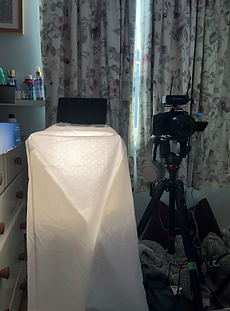

From undertaking the practical research, I found that I liked the more casual style of interviews with one camera but still wasn’t sure if I needed to use them for the documentary. I thought that if I could I would try and do only interviews at the shoots of the dance show as this would bring a more authentic feeling to it and not feel as though the events are being re-told. Though in the back of my mind I do have doubt whether this is the right thing to do, as I feel I need to conduct these at home interviews because I will be too busy to do them at the show.
During the production stage at the dance show, I realised that while it was pretty much not possible for me to conduct interviews throughout the days of the show as everyone is busy with their dances, myself included, also conventionally for the documentary I am creating these interviews are needed for this.
Representation within Documentary
(19/3/24)
Representation is an essential element for me to consider, as I need to think about who I'm filming, what they represent and how I represent them. I need to consider how I represent them as they are real people with real lives, so I need to make sure I am representing them as being them, not someone I've edited the to be. Within this section, I am exploring how I can represent these people as honestly as possible, looking into mediation, stereotypes and ideology.
Mediation -
What is mediation? Meditation is the process that all media products go through before reaching the audience. In terms of documentary, this means how I portray the narrative and the people within the documentary. This is something I will need to take into to consideration throughout multiple stages, but mainly the creative pre-production and post-production stage.
During creative pre-production, mediation is an important step for me to undertake and one which I took into consideration. This happened when I was writing the script, I struggled to actually write the script itself, so rather than focusing on the script itself, I created a concept outline. This was something I re-wrote a couple of times, ensuring it was right for the audience and made sense. Because the documentary is observational, I cannot predict the events that are going unfold, so in post-production I need to keep this in mind and re-work it to fit what has been shot.

12/4/24 – 25/4/24:
When I started post-production, I went through all of the interview footage from the three and created the narrative. This is something that took a lot of time, however I had to re-work it multiple times until I was happy with it. Through mediation I took into consideration what the three were saying, making sure the sentences I was creating made sense and didn’t give off the wrong message. This mediation took place over the entire editing process as I would cut different areas out as I went along, because I realised, they weren’t needed or didn’t make sense.
Below are the a couple of different time lapses where I can be seen editing the footage, utilising mediation to order the interviews as I intend the narrative to be told.
Overall, I would say that mediation is a huge part in representation, regarding documentary, and in terms of this being a problem, I think it was one which I didn’t realise I had encountered. I have been able to use mediation to go over what the interviews are saying and tailoring these during post-production to get the message across that I want the audience to attain.
Stereotypes -
When it comes to stereotypes, this isn’t exactly something I can avoid within my documentary. The dance school which the three pupils attend is from an area where there is little diversity so most of the people who attend are very similar and female. To go with this, I am wanting to use three of the older pupils so that limits who I could include within the documentary. Stereotypes is a problem I need to solve, but the problem is how I cannot divert from them, which is something I had considered.
If I weren’t creating the documentary I am, then I would’ve liked to have created a piece which doesn’t conform to stereotypes. What I mean by this is having people who don’t fit the normal for a genre, as this would show the range of people interested within a certain topic.
In order to overcome this problem, I had to accept that the three people I am using are all female, meaning there isn’t equal female – male representation, but this isn’t needed due to the topic of my documentary. Through conforming to these stereotypes, it means the audience will have a better understanding and be able to recognise the topic. With this, for the intended audience as they are either dancers themselves or the parents, it means that they will be able to relate this to their own life and situation.
Ideology -
Ideology is the ideas and beliefs, often used by media producers, which are then represented within their own media texts. What this means is that the media producers own beliefs often influence what's produced and how its represented. This is a problem I am going to have to solve as I need to ensure I represent the three as they are and not as someone they aren’t, this is especially important for the post-production stage.
With ideology I need to consider what the message is for my documentary and how I present this without letting my own thoughts/beliefs disrupt this. For the documentary, I am unsure what the message exactly is, but this is an issue seeing as all documentaries have a message. I feel rather than a message I want the audience to gain an understanding of this experience the three have shared and their love for dance/the school itself. The three people have known each other for over 10 years and have all been at the school for a very long time, so they will be able to present this shared love quite easily.
While ideology is focused on the message of the documentary, it’s also focused on the representation of gender, race and social class, so linking in with stereotypes. Through the media consistently producing programmes with the same ideologies, the audiences often attain the preferred reading that the producers want, but if a new ideology is presented enough, it becomes normalised/accepted. Regarding ideology in my documentary, this means that I have had to consider who’s being represented within it and who isn’t, and the perspective it’s shown through.
Within the documentary I am representing a female perspective of a dance show and the experience of it. This is a dominant ideology for the genre of documentary I am creating, as it is females talking about their experience within dance, which is pretty cliched.
As a whole ideology is about me understanding the message of the documentary, whose being represented/how they are being represented. With this I need to keep to the narrative I decided on and not let my own beliefs influence how this is told.
Film Form
(26/3/24 - 19/4/24)
A problem I need to think about is film form. Film form is everything I need to take into consideration when creating this documentary. For any media production there are 4 main factors I need to think about such as mise en scene, cinematography, sound and editing. These four factors play a role in any media production, not documentary specific, but they are still used.
Mise-en-scene:
Mise-en-scene is considering everything that is seen in frame and how the elements are arranged. So, for my documentary this will be focused on the interviews and the show footage. The interviews are likely to be conducted within the homes of the three, so I need to ensure that what's in the frame reflects who they are. Doing this will ensure I give the audience an insight as to what they are like outside of the dance show, giving the impression that they have other interests.
3/4/24 -
When shooting Chloe and Ella's interviews, mise-en-scene is something I took into consideration. Both of their rooms were aesthetic and showed a bit of who they are, so when positioning the camera, I tried to capture this. For Chloe’s, her room is covered in pieces of dance artwork/memories, so I wanted the audience to see these as it shows the audience dance is something she cares about a lot. This can be shown in the image below.

Whereas with Ella’s her room was more simplistic, but she had her pointe shoes hung in the corner of her room, so I wanted to have this in frame, as once again this helps the audience understand that dance is something that she loves even outside of being there. This is shown in the image below.

Cinematography:
This is the process of capturing moving images or film, this involves elements such as camera angles, shot types, movement and composition. Cinematography is something I need to consider during the production stage, certainly the show days shoots because while I need to capture the atmosphere of the show and the dances, it still needs to look good. I will chat with my crew about this as well because I want them to understand that while it needs to show the dances and the atmosphere, it needs to be aesthetically good too.
26/3/24 –
Cinematography was taken into consideration with the side of stage shots today. I wanted to capture the view from the wings, as this would allow the audience to understand a different perspective and have, quite literally, a different view. In the image shown below, cinematography has been taken into consideration. This show is through the wings which can be seen as there are two black segments on the left and right of the frame, allowing Emily to be positioned more central in the frame. The shot as a whole looks really lovely as it gives the audience a new view and the framing/composition of the shot works.

Sound:
With films sound is a vital element, as it is in documentaries. There are two types of sound, diegetic (sound within the world of the film) and non-diegetic (sound not in the world of the film), so for documentary diegetic sound is the interviews and raw audio from the show days shoots, whereas non-diegetic is the music in the background of the documentary (added in in post-production).
16/4/24 -
In terms of non-diegetic sound, I used a site called pixabay to find some copyright free music for me to use. Music is an important element to consider during the editing stage as this will help to guide the audience’s emotions and how they view the piece. Because this is a factor to consider, I edited together what the three were saying first, creating a sequence for me to follow and then searched for music to fit this atmosphere I was looking for. As explored in the post-production stage, I was able to find some music quite quickly as I could refine my search with ease.

Editing:
This is where cutting, sequencing and manipulating the film to control the narrative/pacing takes place. For my documentary, this is going to be an essential element for me to focus on. Here I will be deciding the entire pacing, narrative, structure of the documentary. I am unsure on how long this editing will take, however in my action plan I have allocated a month to edit the entire documentary, which I think should be more than enough time. The problem to solve here is how I structure the documentary, even though I created the concept outline, I am still unsure on how I will structure this, but hopefully once all the footage has been shot and logged, I can easily overcome this and structure the documentary, so it flows and makes sense.
To see this problem being overcome click the buttons below to take you to the days of me editing the structure together.